
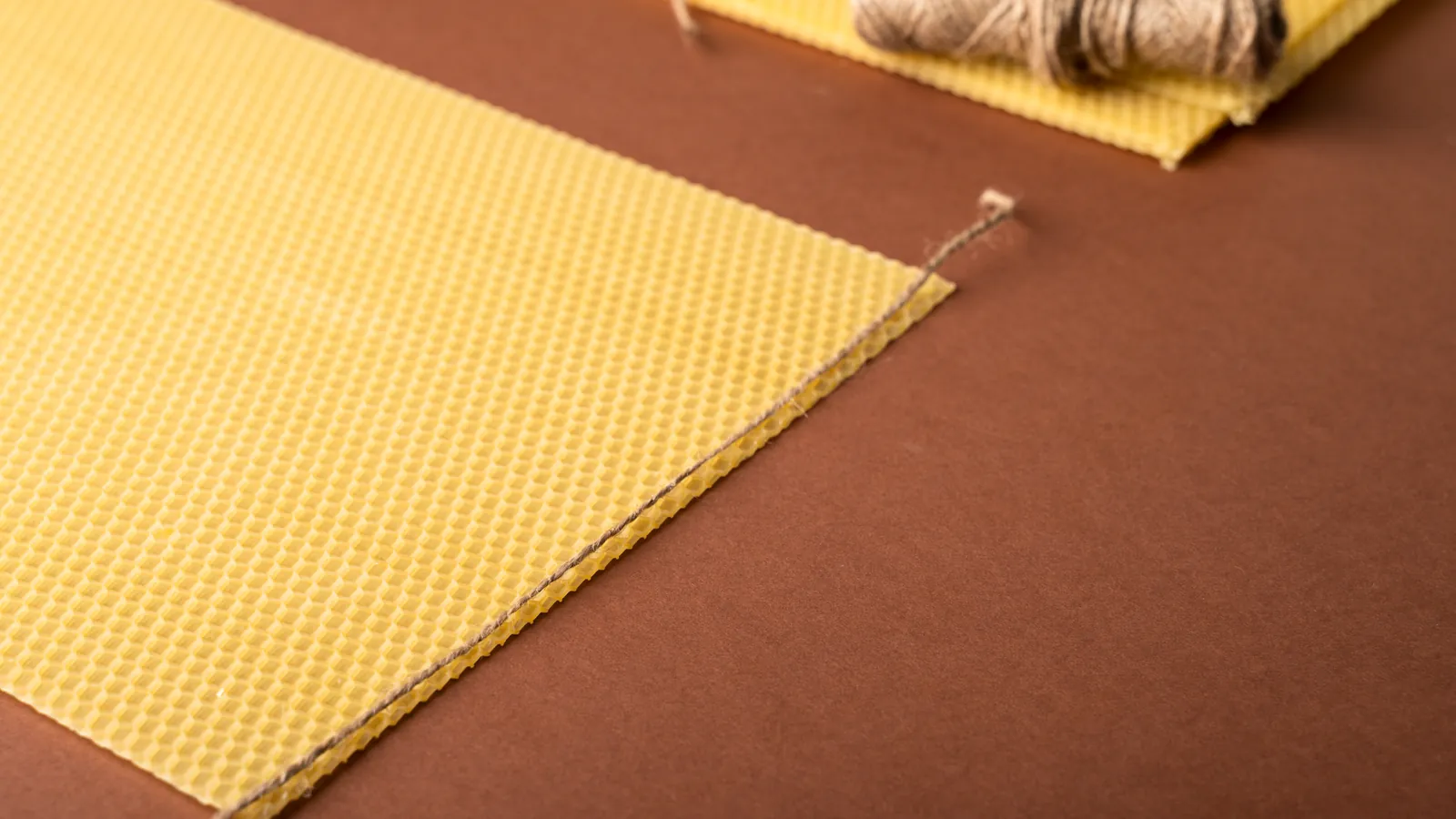
Embossed beeswax foundation is a thin sheet of beeswax printed with the hexagonal pattern of the cells. Bees use it as a guide and build straight comb inside the frame. So the comb can carry the weight of honey and survive the extractor, the frame is wired and the wire is embedded in the wax. This guide shows you how to choose foundation, wire a frame step by step, install it, and avoid the usual tropical mistakes.
- What it does: saves the bees work, organizes comb building and lets you reuse comb after extraction.
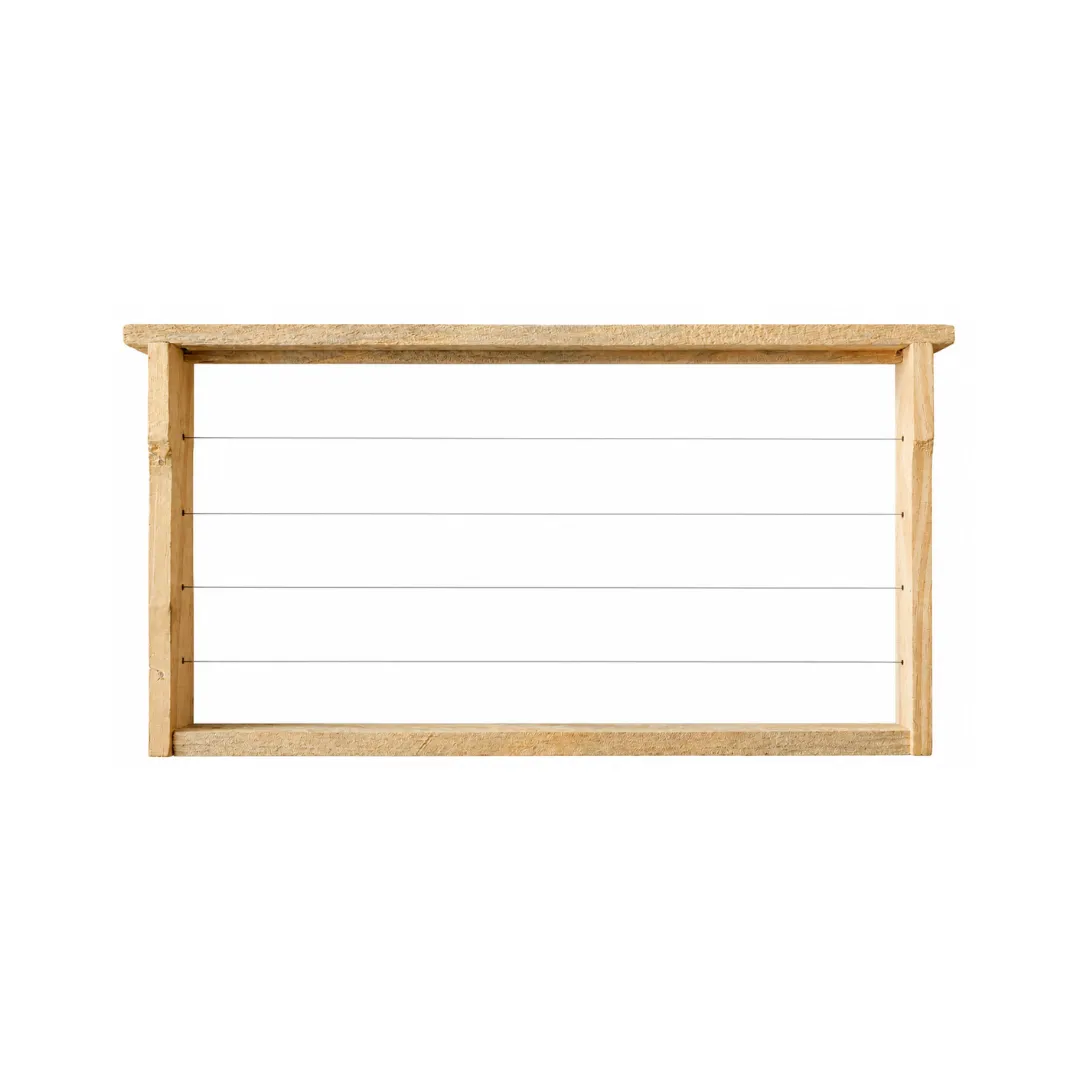
- Wire: a deep Langstroth frame usually takes four horizontal wires, taut but not bowing the side bars. Eyelets stop the wire from cutting into the wood.
- Foundation: embed the wire into the sheet, do not just lay the sheet on top. Too little pressure and it lifts away; too much and the wire cuts through.
- Wax source: studies in other countries found acaricide residues in commercial foundation. Always ask where the wax comes from.
- Quick math: one sheet per frame. A 10-frame box needs 10 sheets, and each sheet costs RD$ 60.00 in our catalog.
What is embossed foundation and what is it for?
It is a sheet of beeswax with the base of the cells already marked. You fit it in the wooden frame so the bees pull out the cell walls from that pattern. A Spanish-language beekeeping source says foundation saves the bees work, organizes their building and lets you reuse comb.
Without a guide, bees build where they like and often leave comb crossed between two frames, which makes the hive hard to open. With foundation the comb is straight and centered, easier to inspect and harvest. If you are still putting your equipment together, start with the beginner equipment guide.
Wax, plastic or no foundation: which one?
There is no perfect option. It depends on how much control you want over the comb and what you are willing to spend.
| Option | Advantages | Keep in mind |
|---|---|---|
| Embossed wax foundation | Straight comb, built quickly. Natural material the bees accept well. | Fragile in heat and cold. Needs wire. The wax can carry residues if its origin is not clean. |
| Plastic comb | Stronger and longer lasting, but also more expensive, according to the source we read. | Higher purchase cost. |
| No foundation (guide only) | Nothing to buy. Bees choose the cell size. | Cross comb is more likely, and a deep frame can take longer to fill. Needs frequent checks. |
For a beginner, wax foundation on a wired frame is the most predictable choice.
What size is the sheet and how many do you need?
Foundation is cut to the frame. As a reference, a US supplier lists a sheet for 9 1/8 inch deep frames at 8 1/2 by 16 3/4 inches, about 7 sheets per pound. That size is that supplier's, not ours: compare the sheet with your frame before buying and trim to the real width, not the nominal one.
Medium and 3/4 boxes use a shorter sheet. We do not give a size we have not verified, so message us on WhatsApp with the box type you use.
Quick sheet calculator
Simple rule: one sheet per frame, 10 frames per box. These numbers are arithmetic, not management advice.
| Your apiary | Frames to fit | Sheets |
|---|---|---|
| 1 hive, 1 deep box | 10 | 10 |
| 1 hive, 1 deep box and 1 super | 20 | 20 |
| 2 hives, 1 deep box and 1 super each | 40 | 40 |
| 5 hives, 1 deep box and 1 super each | 100 | 100 |
| 10 hives, 2 deep boxes each | 200 | 200 |
In later years, count only the frames you replace or renew, plus those for new boxes. Multiply the sheets by RD$ 60.00 (price per unit), or see the box of embossed sheets (RD$ 4,500.00) and ask on WhatsApp how many sheets that box holds for your model.
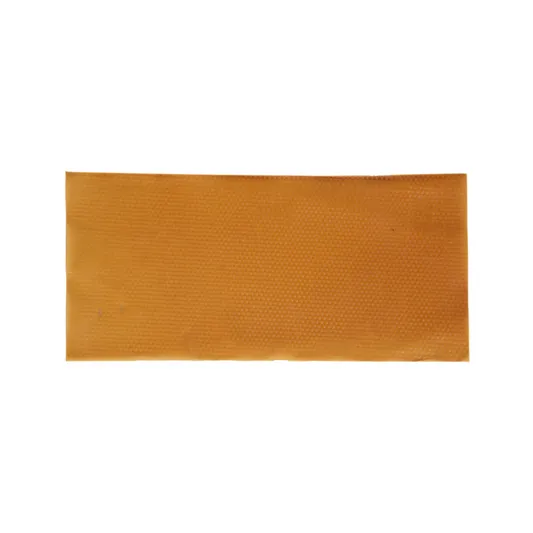
How do you choose good foundation?
1. Pure beeswax, with a known origin
Varroa treatments build up in wax. In the United States, a University of Pennsylvania study (Mullin and colleagues, 2010), summarized by a SARE project, found residues of 27 pesticides across commercial foundation samples, with fluvalinate in 100% and coumaphos in 95%. The same project tested cappings wax from 10 apiaries and found about half as many contaminants, though with a small sample. We have no Dominican data, so ask your supplier where the wax comes from and whether it was tested.
2. Not cracked, warped or heat-marked
Cold wax breaks when handled, and warm wax softens and wrinkles. Check the box on arrival: flat sheets, no cracks, no bent edges.
3. A good fit for your frame
Measure frame and sheet. A tight sheet wrinkles when it warms. A short one joins the side bars poorly and makes weaker comb.
4. Storage before use
Keep sheets flat, in a cool dry place, away from sun and from fuels, pesticides or solvents, because wax absorbs fat-soluble substances. Never leave them in a vehicle in the sun.
Which wire and eyelets do you need?
Wire keeps the sheet from sagging before the bees draw out the comb and keeps the comb from breaking in the extractor. Use steel frame wire, not fishing line or picture wire, because bees can chew those.
- Galvanized wire: 5 lb (RD$ 1,600.00).
- Stainless steel wire: 1 lb (RD$ 400.00) or 5 lb (RD$ 1,800.00). One technical source cites 0.55 mm wire; confirm the gauge with us before buying.
- Eyelets: stainless steel (RD$ 2,950.00) or iron, 1 kg, gold color (RD$ 750.00). They go in the side-bar holes so tight wire does not cut the wood.
- Pre-wired frame: the deep Langstroth frame 9 1/8, wired (RD$ 66.08) skips this step. You only need to embed the sheet.
Stainless does not rust in humid air. It also has more electrical resistance than galvanized wire, so if you embed with a transformer, test the heating time on one frame before doing the rest.
How do you wire a frame step by step?
A deep Langstroth or brood frame usually takes four horizontal wires through both side bars. More wires add no strength and can bow the side bars.
Wiring checklist
- Check the frame. It must be square, clean, with no cracks or open joints. Wax copies any distortion.
- Fit eyelets in the holes, especially in soft wood or reused frames.
- Nail one end of the wire to a side bar, run it through the holes across and back, making parallel, evenly spaced lines. Nail off the end.
- Tension the wire. It should make a clear note when plucked. If the center yields slightly and springs back, it is right. A dull thud means slack. If the side bars bow inward, it is too tight.
- Test the first frame before wiring the rest.
How to embed the sheet
The main rule: the wire ends up inside the wax, not under or on top of the sheet.
- Seat the sheet in the frame: secure the top edge in the groove or against the top bar, centered and flat, covering nearly the full width without forcing it.
- Support the frame on a smooth board that fits inside it. The board keeps the wax flat and controls how deep the wire sinks.
- Embed the wire with one of these: a manual spur (firm pressure, not on cold wax), an electric spur at a steady pace, or an embedding transformer with a continuous wire circuit. Warm a manual spur in hot water and dry it; never over a flame.
- With a transformer, work in short pulses, remove the contacts as soon as the wire starts to sink, and let it cool a few seconds. Do not use battery chargers or connect the wire straight to mains power.
- Check both faces. If a stretch did not embed, fix it with the manual spur at that spot; do not energize the whole circuit again.
- Secure the top edge. In midsummer the sheet can pull away from the top bar. Run a fine bead of melted wax along the join.
If something goes wrong
| Symptom | Likely cause | Fix |
|---|---|---|
| Wire stays on the surface | Not enough heat or poor contact | Lengthen the pulse slightly and clean the contacts |
| Wire cuts the sheet | Too much power or pressure | Shorter pulses; remelt the cut sheet rather than patching |
| Wax cracks under the spur | Sheet too cold | Let it settle indoors in a cool place |
| Sheet ripples as it warms | It was compressed in the frame | Remove it, trim to the real width and refit |
Making your own foundation is a different matter. Our catalog lists a beeswax foundation press plate (RD$ 32,250.00). We only know its name and catalog listing, so if you plan to make your own sheets, message us on WhatsApp to learn what size it produces and how it is used. Homemade foundation is only as clean as the wax you use. If you have a beeswax press (RD$ 8,000.00) you can prepare wax, but the cleanliness of its origin is your responsibility.
How do you install the frame in the hive?
Place new frames in the box with the sheets straight and vertical, without knocking them as you lower them.
- Use a strong colony. A weak colony or one with no nectar flow may chew or draw badly a well-fitted sheet. That is a timing issue, not an installation fault. Give new sheets when the colony is growing and has something to build with.
- Check after a few days. Comb should come out straight on each sheet. If one is crooked, correct it early; built comb is harder to straighten.
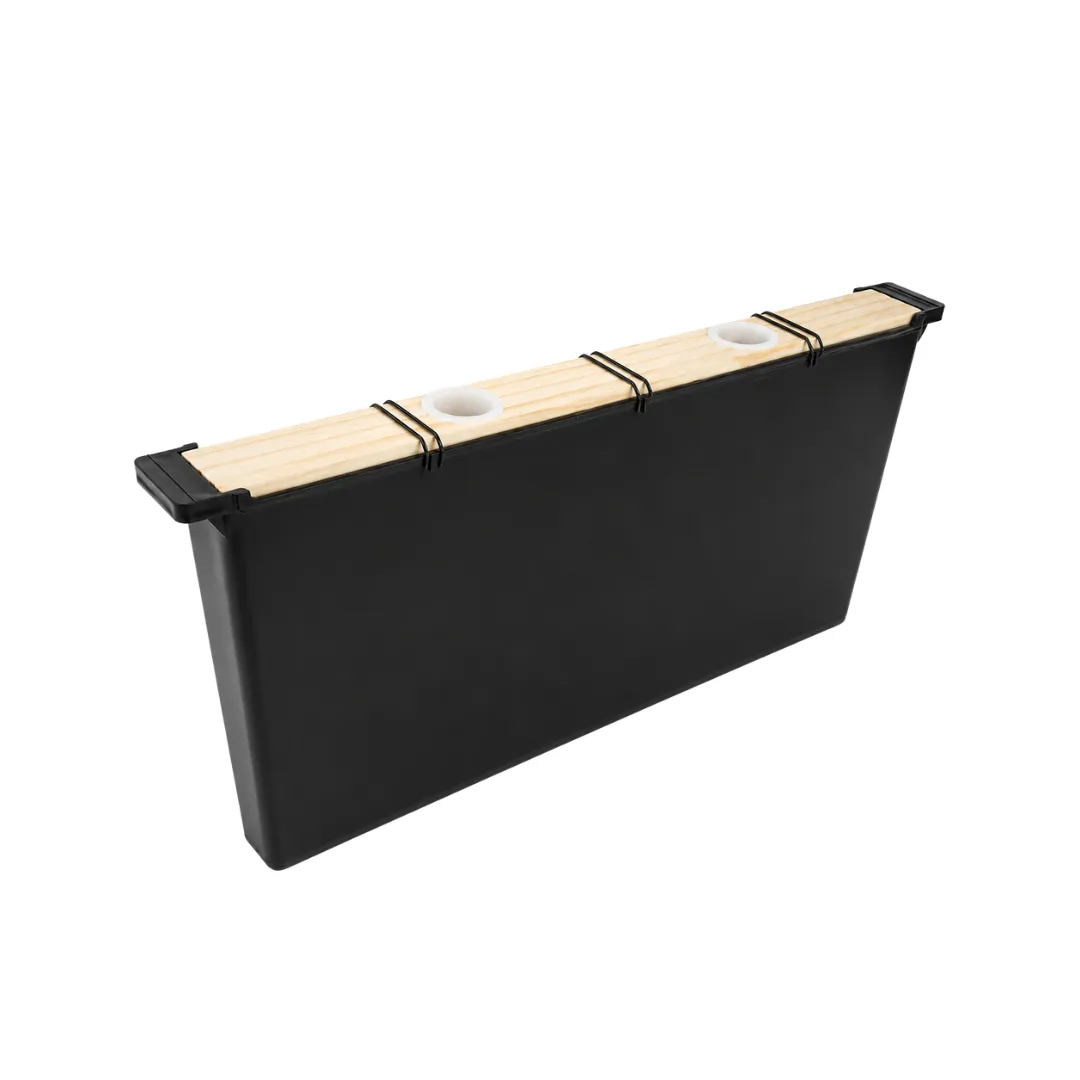
- Feeding helps get started. Uruguay's agriculture ministry advises feeding only when no honey supers are on, giving an amount the bees finish quickly and keeping the internal hive space small. Summer feeding does little and can adulterate honey. Use a 3.5 L frame feeder (RD$ 500.00).
Once the comb is built, see the harvest guide. If you combine different boxes in one hive, the guide to boxes and supers helps you match bodies and frames.
Tropical problems: heat, humidity and wax moth
Heat
Warm wax softens and sags. In summer, work in the shade, take out only a few sheets at a time and never leave them in a vehicle or in direct sun. Store frames upright with no weight on the wax.
Wax moth
The University of Florida explains that moths prefer old, dark comb over foundation or new light comb, and the worst damage is often in stacked supers of dark comb. There is no chemical control in living colonies: a strong, disease-free, queenright colony keeps moths low. For stored equipment, that source lists freezing infested material for at least 72 hours as a safe alternative; handle the frozen wax carefully because it is fragile. For any fumigant, follow the label and national rules.
Humidity and warping
Keep sheets and frames in a cool dry place, flat, protected from dust, knocks and rodents. Check wire tension and that the sheet is flat before use. Our sources give no Dominican critical temperature, so we state no number: the practical rule is to touch the sheet and, if it feels soft, wait or work somewhere cooler.
Common mistakes with wax foundation
- Slack wire: the sheet sags and the comb comes out wavy.
- Over-tight wire: the side bars bow and the wire loses tension within weeks.
- Under-embedding: the wire shows and the sheet lifts away.
- Too much heat: cuts or openings appear in the wax.
- Compressed sheet: it ripples as it warms.
- Warped frame: foundation will not straighten a bowed frame.
- New sheets in a weak colony with no flow: they are ignored or built badly.
Where to buy foundation in the Dominican Republic
Quisqueya Hive is in Santiago and delivers in 24 to 48 hours on business days; shipping cost is quoted on WhatsApp. Here is what we offer for this job, as listed in the catalog:
| Item | What it is for | Price |
|---|---|---|
| Embossed Wax Foundation Sheet (Single) | One sheet for one frame | RD$ 60.00 |
| Box of Embossed Wax Foundation Sheets | Buying by the box for several frames | RD$ 4,500.00 |
| Deep Langstroth Frame 9 1/8, Wired | Frame with wire already strung | RD$ 66.08 |
| Stainless Steel Beehive Frame Wire 5 lb | To wire your own frames | RD$ 1,800.00 |
| Stainless Steel Eyelets | Protect the wood from the wire | RD$ 2,950.00 |
| Beeswax Foundation Press Plate | For anyone who wants to make their own sheet | RD$ 32,250.00 |
Browse the hives and frames and the tools. If you need foundation for a specific box type, message us before you buy.
Frequently asked questions
How many sheets do I need for one hive?
One per frame. A 10-frame box needs 10 sheets; one box plus one super needs 20. If you reuse drawn comb, count only the new frames or those you replace.
Do I have to wire the frame?
A supplier of unreinforced sheets recommends wiring frames for strength. Wire keeps the sheet from sagging and the comb from breaking in the extractor, so it is worth doing on any frame you plan to extract.
What is an eyelet and what is it for?
A small metal piece that goes in the side-bar holes. It stops a very tight wire from cutting the wood and losing tension. It is recommended mainly in soft wood or reused frames.
Can I embed foundation without electricity?
Yes. A manual spur presses the wire into the wax. Use firm pressure and avoid cold wax, which cracks. Warm the spur in hot water, never over a flame, and check that it does not cut the sheet.
Does wax foundation contain acaricide residues?
Studies in other countries found residues in commercial foundation, mainly fluvalinate and coumaphos. Cappings wax was cleaner in one small study. Ask your supplier where the wax comes from and avoid mixing old comb wax of unknown history.
Can I store frames with foundation for a long time?
They can wait if stored flat or upright in a cool dry place, with no weight on the wax and away from strong odors. Before use, check wire tension and that the sheet is still flat and uncracked.
Sources
- La Tienda del Apicultor. How to fit wax foundation into a frame: step-by-step guide. latiendadelapicultor.com
- Honey Bee Suite. What is a wired frame? honeybeesuite.com
- SARE. Are beeswax cappings contaminated with pesticides? (project FS12-261, citing Mullin and colleagues, 2010, PLoS ONE). projects.sare.org
- Jack, C. J. and Ellis, J. D. Wax moth control (ENY121). University of Florida IFAS Extension. ask.ifas.ufl.edu
- Ministerio de Ganadería, Agricultura y Pesca de Uruguay. Recommendations for feeding colonies in spring (in Spanish). gub.uy
- Hansen Honey Farm. Medium brood foundation 8 1/2" (product listing with dimensions). hansenhoneyfarm.com
- Apicultura y Miel. Todo sobre las láminas de cera y de plástico (in Spanish). apiculturaymiel.substack.com
Reference prices from the Quisqueya Hive catalog as of October 2026, subject to change. Product specifications come from catalog listings. This guide is informational.
0 Comments