
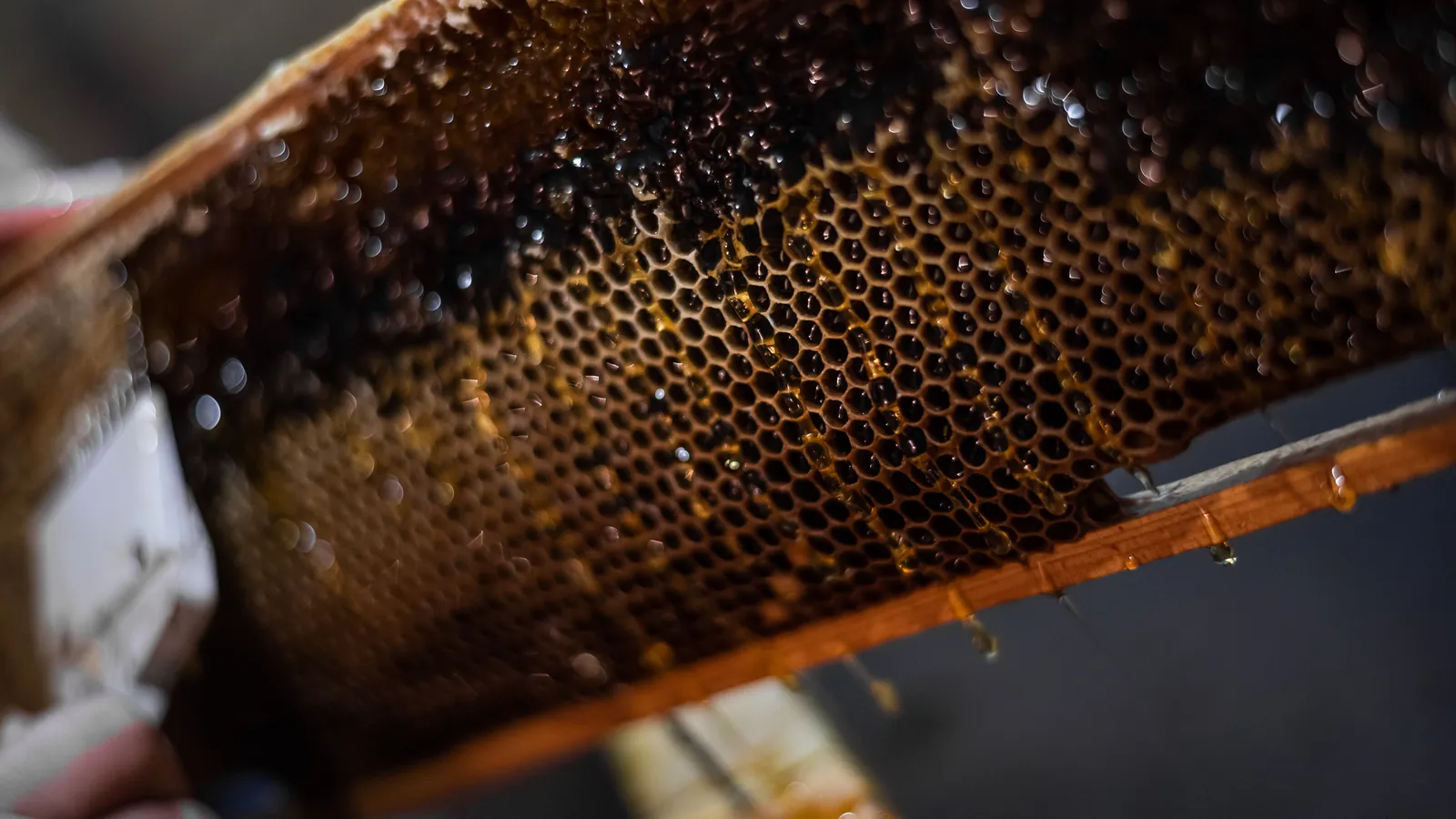
An uncapping table is a stainless steel work table where you rest a frame to remove the thin wax layer that seals the honey (the cappings), catching both the wax and the honey that drips off before the frame goes into the extractor. It pays off when you harvest several supers in a row: it keeps the work orderly and keeps honey and wax off the floor. This guide gives you the full harvest sequence, when to harvest, what equipment fits your scale, and a checklist for extraction day.
- An uncapping table is for when you harvest many supers. With a few hives, an uncapping knife and a tray do the same job for less money.
- Harvest well-capped combs. A Mexican harvest guide asks for 90% capped in highland zones and 100% in tropical zones, and never frames with brood. Measure moisture before bottling.
- Moisture limit: the Codex Alimentarius sets a maximum of 20% and requires that honey has not begun to ferment. A university extraction run with international criteria used 18% as its general limit.
- Work order: clear the bees, uncap, extract, strain, let it settle, measure moisture, bottle, and clean up the same day.
- By scale: with 5 hives, share an extractor; with 20, your own 3 or 4 frame extractor; with 50 or more, an uncapping table plus a 4 frame extractor.
What is an uncapping table and how does it work?
It is a stainless steel work table with a rim, designed so you can uncap frames over it and catch what falls. Uncapping means cutting the thin wax lid the bees put over each cell when the honey is ripe. If you do not remove it, the centrifugal force of the extractor cannot get the honey out.
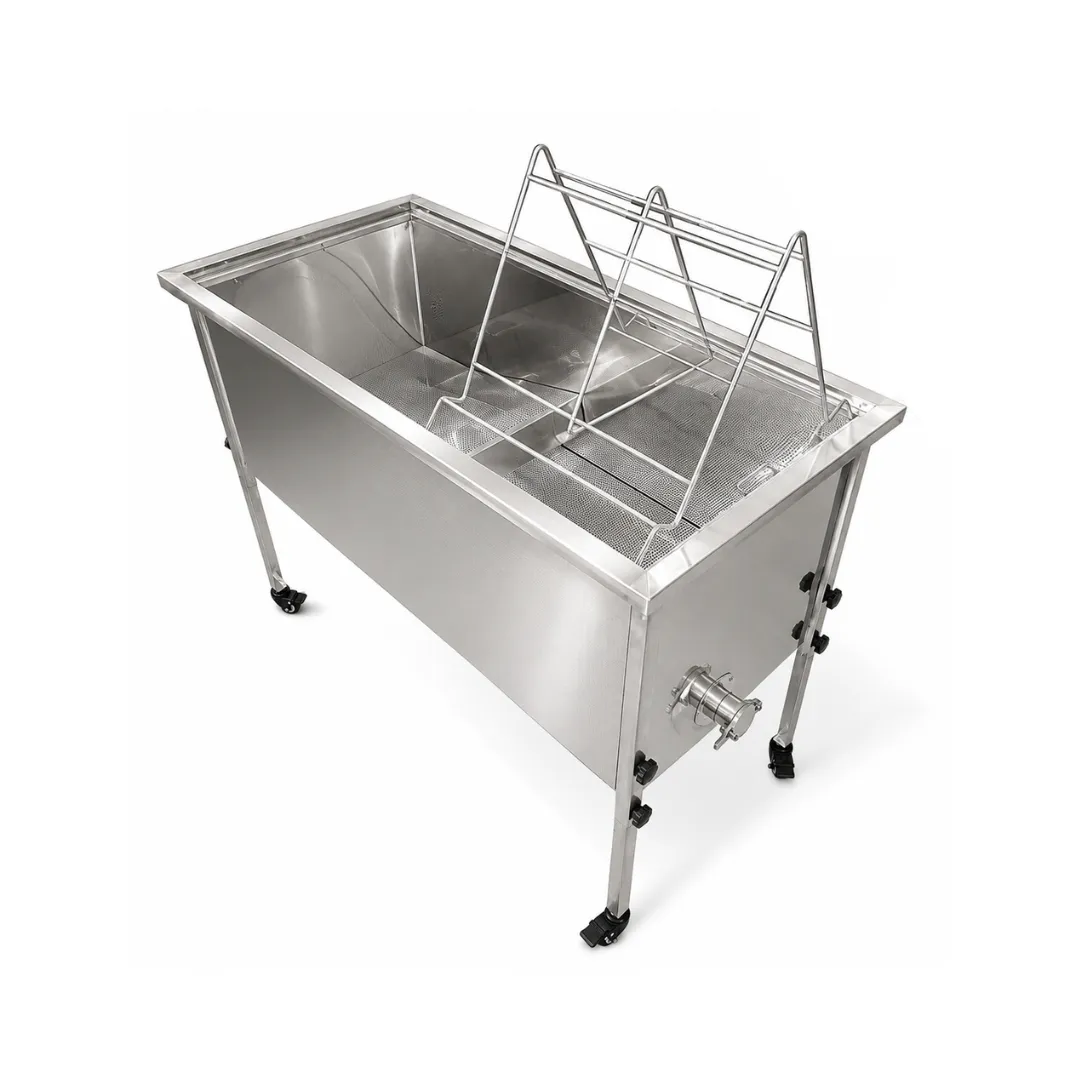
In general, a table like this does three jobs: it supports the frame while you cut, it holds back the cappings while letting the honey they carry drain off, and it gives that honey a way out into a container. Ours, the 304 Stainless Steel Uncapping Table (RD$ 47,200.00), is 304 stainless steel according to its listing name. For dimensions, capacity and accessories, check the listing or ask us on WhatsApp before deciding, because those details change the size of apiary it suits.
How to use it, step by step
- Set the table at a height where you can work with a straight back, with a clean container under the drain for the honey.
- Rest the frame on the support with the top bar up, and uncap with the knife from the bottom up or the top down, without digging into the cells.
- Move the uncapped frame to the extractor and leave the cappings on the table to drain.
- When you finish, gather the cappings for the wax (see below) and wash the table with water.
If you have fewer than about 20 hives, probably not. An uncapping tray (RD$ 9,000.00) and an uncapping knife (RD$ 600.00) cover that scale. A table makes sense when four or five supers in a row become too messy, or when you work with helpers.
When is the honey ready to harvest?
When most of the combs in the super are capped and the moisture, measured with a refractometer, is below your limit. Bees cap the cells once the honey has lost the water the nectar carried, so capping is a good indicator, though not a guarantee.
How many combs should be capped
A harvest guide from Mexico's BM Editores asks for combs capped at 90% in northern and highland zones and 100% in tropical and subtropical zones, and reminds you not to harvest frames with brood. The Dominican Republic is tropical, so aim for the strict end: wait until almost the whole comb is closed and harvest only brood-free frames.
How much water can honey have
The Codex Alimentarius (standard CODEX STAN 12-1981, revised 2001) allows up to 20% moisture in most honeys and requires that honey has not begun to ferment or foam. In a report on an extraction run with international quality criteria at Universidad Veracruzana, the general limit applied was 18%. To stay on the safe side in a humid tropical climate, aim for 18% or less. That is a practical target, not a Dominican legal requirement: we found no local rule that sets a different figure.
How to measure with a refractometer
A portable refractometer (RD$ 2,400.00) reads moisture from a drop of honey placed on the prism. Test several samples from different frames and different parts of a frame, because honey within one super can vary. Follow your instrument's manual for calibration and temperature. It helps to measure twice: on a capped frame before harvesting if you have doubts, and on the strained honey before bottling.
To know when your area blooms, use the calendar in the guide to starting beekeeping.
How do you clear the bees from the supers?
With a brush, a blower, an escape board, or a fume board with an approved repellent. The University of Florida extension service describes three routes.
- Physical: brush the bees off each frame with a bee brush (RD$ 400.00) and put the cleared frame in a lidded box. For bigger jobs, lay the supers on their side and use a leaf blower, starting about 10 feet (3 m) away and moving closer if needed. Some bees will come back, so repeat as necessary.
- Escape board: it goes between the brood chamber and the supers so bees can leave but not easily return. The source says to come back in 24 to 48 hours. Leaving supers longer risks small hive beetles, ants and wax moth larvae.
- Fume board with repellent: use only a repellent approved for this job and follow the time on its label. It smells strong.
The BM Editores guide states that phenic acid and mirbane essence are prohibited as repellents because they contaminate honey and are carcinogenic to the beekeeper. If a product is not labeled for this task, do not use it.
Before carrying supers into the extraction room, check them outside and remove any remaining bees, because bees fly toward light and end up inside the house. Wear full protection and keep the smoker at hand, but use smoke sparingly: too much can leave a smoky taste in the honey.
The harvest work order, step by step
Always the same order: clear the supers, uncap, extract, strain, settle, measure, bottle and clean. The times in the table are the ones we found in sources; the rest depends on your pace, which is why there is a note to record yours on your first harvest.
| Step | What you do | Reference time | Equipment |
|---|---|---|---|
| 1. Prepare | Escape board the day before, or brush and blow the same day | 24 to 48 h with an escape board | Brush, blower, escape board |
| 2. Move | Supers to a closed room, no frames with brood | Record yours | Lidded boxes |
| 3. Uncap | Cut or scratch the cappings | Record yours | Knife, roller, tray or table |
| 4. Extract | Spin, flip the frame, spin the other side | 3 to 5 minutes per run in a documented hand-cranked extractor | Extractor |
| 5. Strain | Honey passes through a double sieve into a bucket | Record yours | Double sieve |
| 6. Settle | Wax and bubbles rise; clean honey comes out the bottom | 24 hours on average at processing plants | Bucket with gate |
| 7. Measure | Refractometer on the strained honey | Record yours | Refractometer |
| 8. Bottle | Draw honey off through the gate into jars | Record yours | Gate, clean dry jars |
| 9. Clean up | Wash with water, recover the wax, return the wet frames | Record yours | Water, buckets, sieve |
The 3 to 5 minutes in row 4 come from the sheet of the Centro de Tecnología Apropiada in Pontón de la Vega, which documented a hand-cranked four frame extractor. The 24 hours of settling come from the BM Editores guide, which describes plants with settling tanks. In a small harvest you may settle for more or less time depending on the honey; what matters is that wax and bubbles rise before you bottle.
Uncapping: knife, roller, tray or table
For a few frames, knife and tray; for many, a table. The BM Editores guide says cappings are normally cut with a heated knife, and that large operations use uncapping machines.
| Tool | What it does | Best for | Price |
|---|---|---|---|
| Uncapping knife | Cuts the wax layer off the frame. Stainless steel with a wooden handle. | Any scale | RD$ 600.00 |
| Uncapping roller | Pierces the cappings without cutting the surface. | Add-on, spots the knife cannot reach | RD$ 550.00 |
| Uncapping tray | Catches cappings and honey while you work a frame. Stainless steel. | 1 to 20 hives | RD$ 9,000.00 |
| Uncapping table | Large 304 stainless steel surface to uncap and drain. | Many supers in a row | RD$ 47,200.00 |
The Spanish retailer Suministros Apícolas describes an uncapping tray for a single frame: a perforated stainless steel insert over a tray, where the cappings and the dripping honey fall. That is the logic of our tray, and the table takes it to a larger scale. The knife, meanwhile, is the tool nothing replaces: even with a table, someone has to cut the frame.
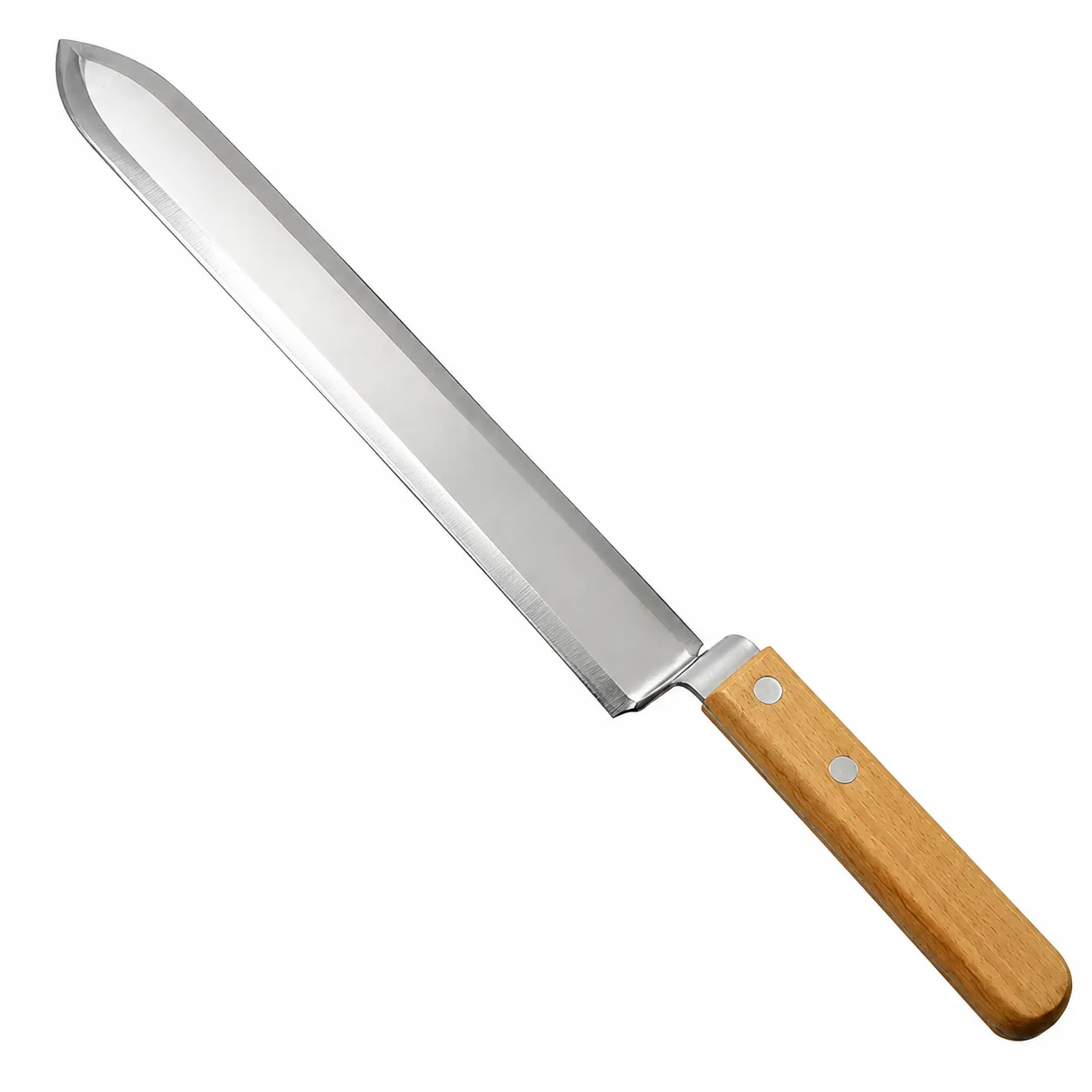
The knife in our store is manual, not electric. Some beekeepers warm it in hot water and dry it before cutting. A cold knife also works, but cut with more care.
Which extractor: manual 2, 3 or 4 frame?
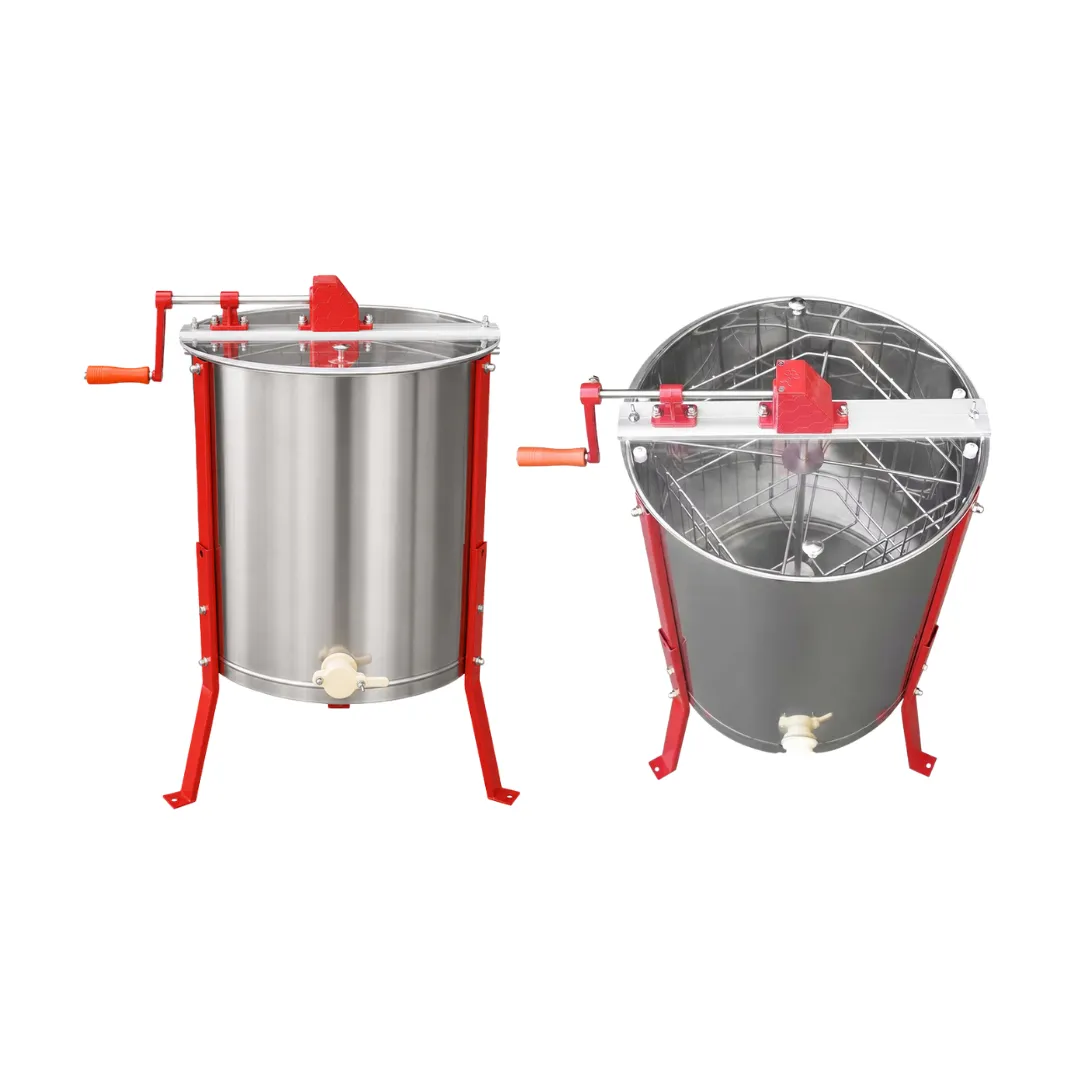
A 2 frame is enough for a handful of hives; a 4 frame saves a lot of time when you harvest several supers. The extractor spins uncapped frames inside a drum and centrifugal force throws out the honey without breaking the comb, which goes back to the hive clean. The BM Editores guide explains that extractors can be tangential or radial, with a vertical or horizontal axis.
| Extractor | Frames per run | Price |
|---|---|---|
| 2-Frame Manual Honey Extractor, 304 Stainless Steel | 2 | RD$ 19,750.00 |
| 3-Frame Manual Honey Extractor, 304 Stainless Steel | 3 | RD$ 23,250.00 |
| 4-Frame Manual Honey Extractor, 304 Stainless Steel | 4 | RD$ 26,750.00 |
Tangential or radial
In a tangential extractor the frames sit with one face toward the drum wall; you spin, flip the frames and spin again, as in the hand-cranked model documented in the country. In a radial one they sit like the spokes of a wheel and empty on both sides at once. The listings of our manual extractors do not say which type they are; ask us before buying if that detail matters to you.
A hand-cranked machine does a simple job, but do not expect industrial speed.
Straining, settling and bottling: sieve, bucket and gate
Strain, let it settle in a closed bucket, and bottle through a gate from the bottom. Honey leaving the extractor carries bits of wax. Run it through a 16 cm stainless steel double sieve (RD$ 1,100.00) or the 32 cm one (RD$ 1,700.00), which rests on the bucket. The BM Editores guide describes straining first and then settling, with the wax rising to the surface to be skimmed off.
To bottle without ladling, fit a gate (valve) to a food-grade bucket. We have the 45 mm stainless steel valve (RD$ 800.00) and the plastic valve (RD$ 450.00). Buckets and jars are not in our catalog: buy food-grade buckets locally. If you receive sealed buckets, the bucket opener (RD$ 200.00) opens them without damage.
Fit the valve low, a few centimeters above the bottom, so the wax and foam floating on top do not reach the jars, and let the honey flow on its own. Do not heat the honey to make it pass the sieve faster: the Codex says honey must not be heated to the point of impairing its composition, and Clemson Extension warns that excess heat changes color and flavor.
Moisture and fermentation in the Dominican climate
Honey is hygroscopic: it absorbs moisture from the air. In a humid climate, the risk does not end at harvest. A Clemson Extension bulletin (Hoover, 2017) sums it up: store honey in a clean, airtight container, because added moisture creates favorable conditions for mold and yeast. And the Codex requires that honey has not begun to ferment or foam.
- Harvest ripe honey: capped combs and frames without brood. Unripe honey carries more water.
- Extract the same day, in a closed room, with frames kept out of the rain.
- Cover the buckets during settling and between steps.
- Measure before bottling, and if one super reads higher than the others, set it aside and do not blend it in.
- Bottle in clean, dry jars with tight lids.
We give no drying figures because we found none in an official source that we opened.
Cleaning, hygiene and wax recovery
Wash everything with water after the day's work and keep the cappings apart to melt them. On hygiene, the Codex recommends preparing and handling honey following the General Principles of Food Hygiene of the Codex Commission, and asks that honey not take on objectionable flavors or odors from foreign matter during processing and storage.
- Work in a closed, clean space, not an open yard: honey draws bees and ants.
- Wash and dry every utensil that touches the honey.
- Avoid containers that held strong-smelling products: the Codex asks that honey not pick up foreign odors or flavors.
- Store bottled honey in a cool place, in clean airtight containers (Clemson).
- Babies under one year should not eat honey, according to the same bulletin, because of infant botulism. Tell your customers.
Cappings wax
According to University of Florida Extension, the cleanest wax usually comes from cappings, which are the newest comb. A solar melter, a glass-topped box, is the usual way to melt it, and UF says it must be bee-tight because the smell of melting wax attracts bees. Before melting, let the cappings drain or rinse them to recover the honey. For larger volumes there is the beeswax press (RD$ 8,000.00), and you can read how to reuse wax in our wax guide.
Return the extracted frames to the hives so the bees can clean them and reuse them. Do it soon, so wet frames do not sit around in the room.
Equipment by scale: 5, 20 or 50 hives
Do not buy for the apiary you dream of, but for the one you have. This table proposes what to buy at each scale; the hive counts are our own reference to organize the catalog, not an industry rule. Reference prices from the Quisqueya Hive catalog as of October 2026.
| Item | 5 hives | 20 hives | 50 or more |
|---|---|---|---|
| Uncapping | Knife (RD$ 600.00) | Knife and tray (RD$ 9,000.00) | Uncapping table (RD$ 47,200.00) and knife; roller optional (RD$ 550.00) |
| Extractor | Share or rent; if you buy, 2 frame (RD$ 19,750.00) | 3 frame (RD$ 23,250.00) or 4 frame (RD$ 26,750.00) | 4 frame (RD$ 26,750.00); look at a larger extractor if your volume needs it |
| Straining | 16 cm sieve (RD$ 1,100.00) | 32 cm sieve (RD$ 1,700.00) | 32 cm sieve and a spare |
| Bottling | Food-grade bucket with plastic valve (RD$ 450.00) | Bucket with stainless valve (RD$ 800.00) | Several buckets with stainless valves |
| Measuring | Refractometer (RD$ 2,400.00) | Refractometer | Refractometer |
| Wax | Homemade solar melter | Homemade solar melter | Wax press (RD$ 8,000.00) |
| Clearing bees | Brush (RD$ 400.00) | Brush and blower | Escape boards or blower |
This is a starting point. Our extractors are manual, up to 4 frames; if you outgrow that and need something bigger, write to us and we will talk it through. If you are just starting out, first read the starter equipment guide, which explains what can wait until the second year.
Harvest day checklist
Print this list and go through it the night before.
- Capped frames without brood; honey measured or checked with a refractometer.
- Escape boards in place 24 to 48 hours earlier, if you use them.
- Clean, closed room with a stable table; floor covered.
- Buckets, sieve and gate washed and dry.
- Jars clean, dry and with lids.
- Full protection, smoker and brush.
- Water for cleaning and a container for the cappings.
- Frames out of the supers with no bees; boxes with lids.
- Uncap, extract, flip, strain.
- Cover the buckets between steps; let it settle.
- Measure moisture before bottling.
- Bottle, close and date.
- Wash everything with water; cappings apart.
- Return the extracted frames to the hives.
Rent or share the extractor?
In the first years, yes. An extractor is a big investment used a few times a year. Ask other beekeepers in your area or your association whether they can lend you theirs, and bring your own buckets, sieve and jars so equipment is not mixed. In the equipment guide we explain why we recommend not buying one in the first year. Once you harvest every year, owning your own gives you freedom over dates, which matters when the honey is ready and the weather does not wait.
Frequently asked questions
What is an uncapping table?
It is a stainless steel table with a rim where you rest a frame to remove the cappings, the wax the bees use to seal ripe honey. It catches the wax, lets the honey drain off and keeps the work area clean before the frame goes to the extractor.
What size of uncapping table do I need?
It depends on how many frames you harvest at once and whether you work alone. Check the dimensions on the listing, make sure a Langstroth frame fits comfortably, and that the height lets you work upright. If in doubt, write to us on WhatsApp with your number of hives.
How many combs must be capped before harvesting?
A Mexican harvest guide asks for 90% in highland zones and 100% in tropical zones, and not harvesting frames with brood. It is a strict but safe criterion in the humid tropics. Confirm with a refractometer whenever you have doubts.
How much moisture can honey have?
The Codex Alimentarius allows up to 20% in most honeys and requires that it has not begun to ferment. Universidad Veracruzana applied 18% as its general limit in an extraction with international criteria. Measure with a refractometer before bottling.
Do I need an extractor with only a few hives?
Not necessarily. Sharing or renting another beekeeper's extractor costs less than buying one, and what you do need is a knife, a sieve and a refractometer. Your own extractor makes sense when you harvest every year and want to choose your dates.
How do I keep honey from fermenting?
Harvest capped combs without brood, extract the same day in a closed room, measure moisture before bottling, and store the honey in clean, dry, airtight containers. Honey absorbs moisture from the air, so a good seal is key in a humid climate.
What do I do with the cappings wax?
Let it drain, rinse it to recover the honey, and melt it in a closed solar melter so bees cannot get in. Cappings wax is usually the cleanest. For larger volumes you can use a wax press.
Sources
- BM Editores. "Cosecha y procesos de la miel". Entorno Pecuario. bmeditores.mx
- Codex Alimentarius Commission (revised 2001). Codex Standard for Honey, CODEX STAN 12-1981. FAO and WHO. copy at honeytraveler.com
- Yarborough, J. K. (2022). Honey harvesting: honey out of the hive. UF/IFAS Extension, Orange County. blogs.ifas.ufl.edu
- Sanford, M. T. and Bustamante, T. Solar beeswax rendering and hints for exhibiting wax blocks (ENY111/AA157). UF/IFAS Extension. ask.ifas.ufl.edu
- Hoover, A. (2017). All about honey (HGIC). Clemson Cooperative Extension. ucfoodsafety.ucdavis.edu
- Cruz, C. (2005). "Realiza Laboratorio de Apicultura primera extracción de miel con criterios de calidad internacional". UniVerso no. 185, Universidad Veracruzana. uv.mx
- Centro de Tecnología Apropiada, Pontón de la Vega (2009). Extractor centrífugo de miel de abejas, República Dominicana (sheet A116). Ideas Online. ideassonline.org
- Suministros Apícolas. Mellarius uncapping tray, stainless steel (product page). suministrosapicolas.es
Reference prices from the Quisqueya Hive catalog as of October 2026, subject to change. Product specifications come from the listings. This guide is informational.
Browse our extraction equipment and tools, or message us on WhatsApp with your number of hives and we will help you choose, no obligation. Delivery takes 24 to 48 hours on business days.
0 Comments