
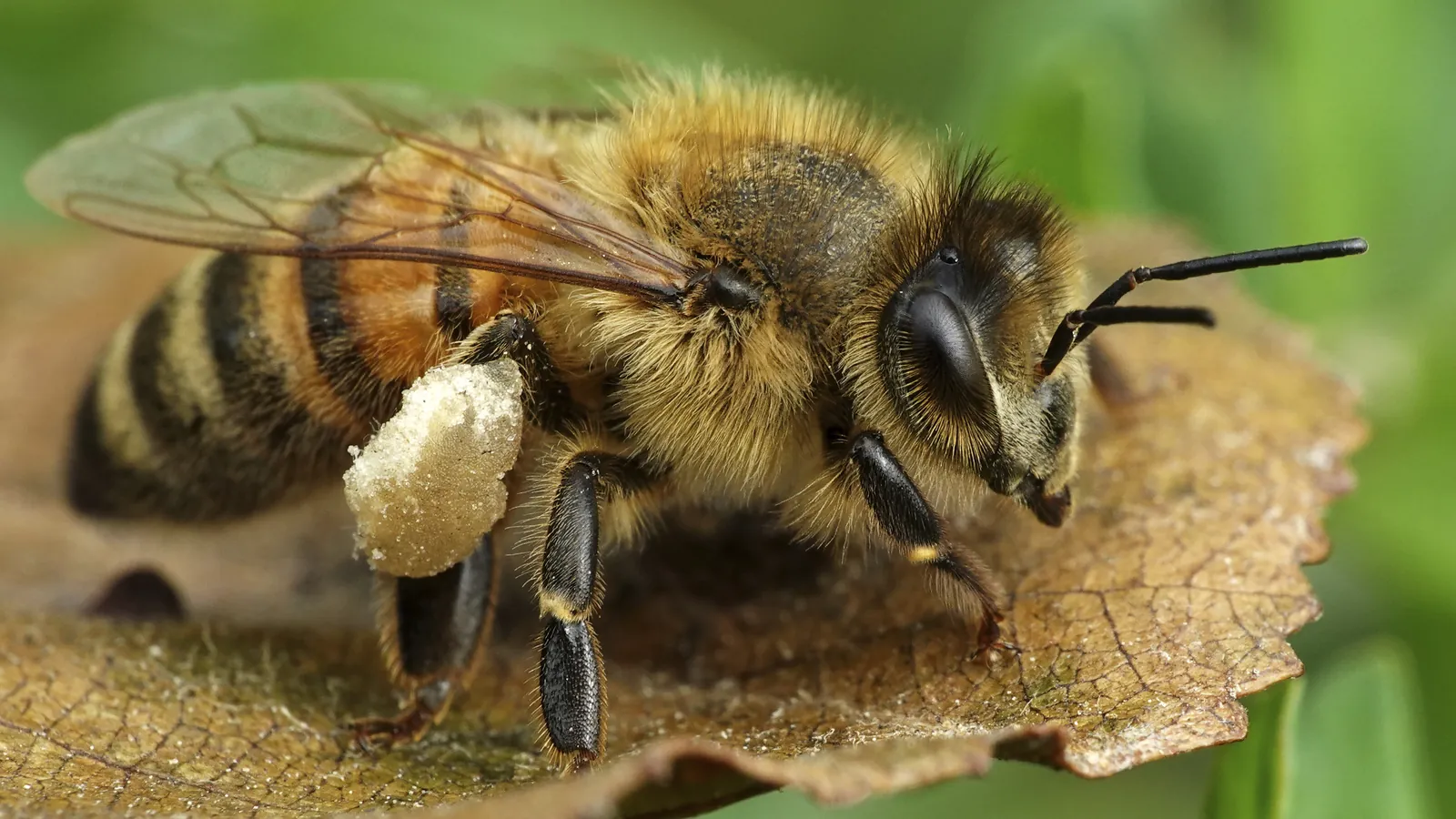
Mavrik 24 EW is an agricultural insecticide whose active ingredient is tau-fluvalinate. Its label describes it for ornamental plants and crops, not for beehives, and it has no directions for varroa. The same active ingredient does appear in strips made for bees, but that does not make the farm product safe or advisable inside a hive. Here is why, and which bee-labeled alternatives you can use instead.
- What it is: Mavrik 240 EW (24 EW) is a water-based emulsion of tau-fluvalinate for plant pests. The labels we opened do not mention varroa or beehives.
- Why we do not recommend it: off-label use, fluvalinate residues that persist in wax, documented varroa resistance, and low efficacy in one field study.
- Measure before you treat: alcohol wash. One university extension uses 3 mites per 100 bees as the treatment threshold from May to October.
- Bee-labeled alternatives: oxalic acid, formic acid, thymol, amitraz and flumethrin, each with its own temperature window and honey super rules.
- What we could not verify: which products are registered in the Dominican Republic today. Ask Digega or your association technician.
What is Mavrik 24 EW and what does its maker intend it for?
It is a contact insecticide for agriculture whose active ingredient is tau-fluvalinate, a pyrethroid. EW stands for oil-in-water emulsion: a concentrated liquid that is mixed with water.
We opened two official manufacturer documents instead of repeating what circulates in forums:
- ADAMA East Africa product page (Mavrik 240 EW): describes it as an insecticide for aphids, thrips and mites on roses and carnations, acting by contact and as a stomach poison. It lists tau-fluvalinate as the active ingredient, a concentrated aqueous emulsion (EW) and warns that it is toxic to fish. It does not mention bees, hives or varroa.
- US EPA label (Mavrik Aquaflow, registration 2724-478, accepted July 2022): contains 22.3% tau-fluvalinate (240 g/L) and is intended for greenhouse, nursery and ornamental plants. On bees it says the product is toxic to honey bees if they are exposed to direct application, that dried residues are non-toxic, and that it should be applied when bees are not foraging. It lists no use inside beehives.
The "24 EW" many beekeepers search for corresponds to the 240 g/L concentration. The US label belongs to a product with a similar name, not necessarily identical to what is sold in each country. We found no label for a Mavrik 24 EW registered in the Dominican Republic in any document we opened, so we could not verify it.
Two points follow from those documents. First, the sentence about bees concerns spraying crops with bees foraging nearby, not placing the product in a hive. Second, neither label includes use inside the hive, and it is the manufacturer together with the registering authority who define permitted uses.
How is Mavrik related to Apistan strips?
They share the same active ingredient, fluvalinate, but they are different products. Apistan is a plastic strip with 10.25% fluvalinate that was formulated and registered for use in hives, with instructions for placement, time in the hive and removal before honey supers (the University of Hawaii table lists a 42-day treatment and requires removing honey supers before applying).
Mavrik, by contrast, is a liquid concentrate for spraying plants. Both containing fluvalinate does not make them equivalent: the concentration differs, so do the other ingredients (the EPA label lists 77.7% as "other ingredients"), and so does the delivery form. That is why official programs say to use only the product labeled for bees.
It is understandable that many beekeepers tried it: the active ingredient was familiar, the price was lower, and varroa does not wait. We are not here to point fingers. We are here to show what the studies say so you can decide with data.
Why is a farm product not recommended inside a hive?
For four reasons, each backed by sources we opened.
1. Label and accountability
A farm product is only evaluated for what its label describes. For use inside a hive there is no manufacturer information on a safe dose, contact time or effect on the queen and brood. If something goes wrong, there is no technical backing. That is why in this article we give no dose, dilution or method for Mavrik.
2. Residues that stay in the wax
A Spanish study (Benito-Murcia and colleagues, 2021, Insects) measured tau-fluvalinate residues in wax and bee bread from colonies that had not received that acaricide for four years. It found widespread, persistent contamination. The authors recommend using clean wax and regulating the source of recycled wax. If you turn your own wax into foundation, that residue travels with it: read our beeswax guide. For the registered Apistan strip, the Hawaii table warns that treated wax must not be used for human consumption and that the strip must not touch comb with honey intended for consumption.
3. Varroa resistance to fluvalinate
An article from the University of Sussex (Al Toufailia and Ratnieks, 2016) notes that resistant varroa was first reported in Italy in 1992 and in Britain in 2001. Where mites are not resistant, Apistan can kill almost 100% of them; where they are, about 30%. In its own trial on broodless hives, the strips killed 58% of mites in colonies with no recent treatment and only 33% in colonies treated four months earlier. One treatment was enough to make the next one less effective. The Spanish study also found a rise in the frequency of the pyrethroid-resistance allele in the mites.
4. Low efficacy measured in the field
A study in Algeria (Adjlane and colleagues, 2013, Acarina) compared a traditional Mavrik preparation with bee-labeled products. The Mavrik preparation reached 44.21% efficacy, versus 91.62% for Bayvarol, 86.50% for Apivar and 77.75% for Apistan. It is one study in one country, with a method we do not describe or endorse, but it points the same way as the rest: this is not a good bet.
We do not claim Mavrik is legal or illegal in the Dominican Republic: we found no opened official source that says so. What we can say is that its label is agricultural and that the alternatives below are made for bees. To confirm the legal situation, ask the Dirección General de Ganadería (Digega) or your association technician.
How do I know if my colonies need treatment?
Measure with an alcohol wash and compare against a threshold. Do not treat out of habit or on a fixed calendar: IDIAF says to monitor before, during and after each treatment, to learn whether it worked and to detect mites resistant to the product.
Alcohol wash, step by step
- Take a sample of bees from a brood frame (take care not to scoop up the queen). Mississippi State Extension uses about 400 bees, half a cup.
- Put them in 70% alcohol and shake to dislodge the mites.
- Pour the liquid through a mesh that lets mites pass and count them on a white tray.
- Calculate: mites counted ÷ bees × 100 = mites per 100 bees.
The same extension uses 3 mites per 100 bees as the treatment threshold from May to October and 1 per 100 in February (it states there is no research-based threshold for February). These are US figures. IDIAF sets no numeric threshold; use them as a reference and ask your local technician.
You can do the inspection with a medium stainless steel smoker (RD$ 2,100.00) and your protective gear. If you are just starting, our beekeeping starter guide also explains varroa and its life cycle.
Bee-labeled treatments compared
Choose by temperature, whether honey supers are on, and where the colony is in its brood cycle. The table gathers what the opened sources say (US labels and extension tables, plus the IDIAF guide). Products and temperatures cited come from US labels: products available in the Dominican Republic may differ, and the label of the one you buy overrides this table.
| Option | Bee label | Temperature window | Honey supers | Residue risk | Resistance | Notes |
|---|---|---|---|---|---|---|
| Mavrik 24 EW (tau-fluvalinate) | No. Agricultural label | Not applicable | Not applicable | Fluvalinate persists in wax (Spanish study) | Fluvalinate resistance documented | No hive use on the opened labels. We give no dose |
| Oxalic acid (dribble, vaporization or strip) | Yes, depending on the product | 37 to 105 °F (3 to 41 °C) in the SARE sheet | Depends on the product: SARE lists it as usable during a honey flow; the Hawaii table marks two dribble products "no" | Naturally present in honey; IDIAF warns of residues if used carelessly | No evidence of resistance per the Aluen CAP developer (not independently verified) | Works best with little brood. Toxic to brood per Hawaii |
| Formic acid | Yes (for example Formic Pro, Mite Away) | 50 to 85 °F (10 to 29 °C) | Yes, per label (Hawaii table and SARE) | Low per the opened sources | No data found in the opened sources | Reaches mites inside brood. Some brood and adult bee loss can occur |
| Thymol | Yes (Apiguard, ApiLife Var) | 59 to 105 °F (15 to 41 °C) for Apiguard; 64 to 95 °F (18 to 35 °C) for ApiLife Var | No: do not use during a honey flow | Can taint honey (SARE on ApiLife Var) | No data found in the opened sources | Acts by sublimation. IDIAF cites 10 to 25 °C as the range where queen laying was not affected |
| Amitraz (Apivar, Colmesan) | Yes | The Apivar label text we opened sets no range | No: remove supers first and wait 14 days before putting them back | No residue data found in the opened sources | The label warns of resistance; the 2025 SARE sheet says resistant mites exist | 42 days in the hive, 56 maximum. Rotate the active ingredient |
| Flumethrin (Bayvarol) | Yes, per IDIAF | Not verified | Not verified | Not verified | Not verified | Highest efficacy in the Algerian study (91.62%) |
| Fluvalinate strips (Apistan) | Yes, but with resistance | Not verified | No: remove supers | Treated wax unfit for human consumption (Hawaii) | High in several countries | The 2025 SARE sheet leaves it out because of resistance |
Two integrated management practices from IDIAF complement any treatment: rotate the active ingredient between treatments (and reuse the same molecule only after about two years), and treat all nearby apiaries at the same time to avoid reinfestation. IDIAF also acknowledges that organic products rarely match chemicals in speed and efficacy and that their results vary, which calls for closer follow-up.
In its 2022 guide IDIAF names registered products based on formic acid (BeeVar), oxalic acid (OxaVar) and amitraz (Colmesan, Apivar, Miticur), and thymol (ApiLife Var). It is the only Dominican listing we opened; we could not confirm which are still registered today or where they are sold.
One option in our catalog: Aluen CAP
Aluen CAP is one oxalic acid strip option, not the only one. 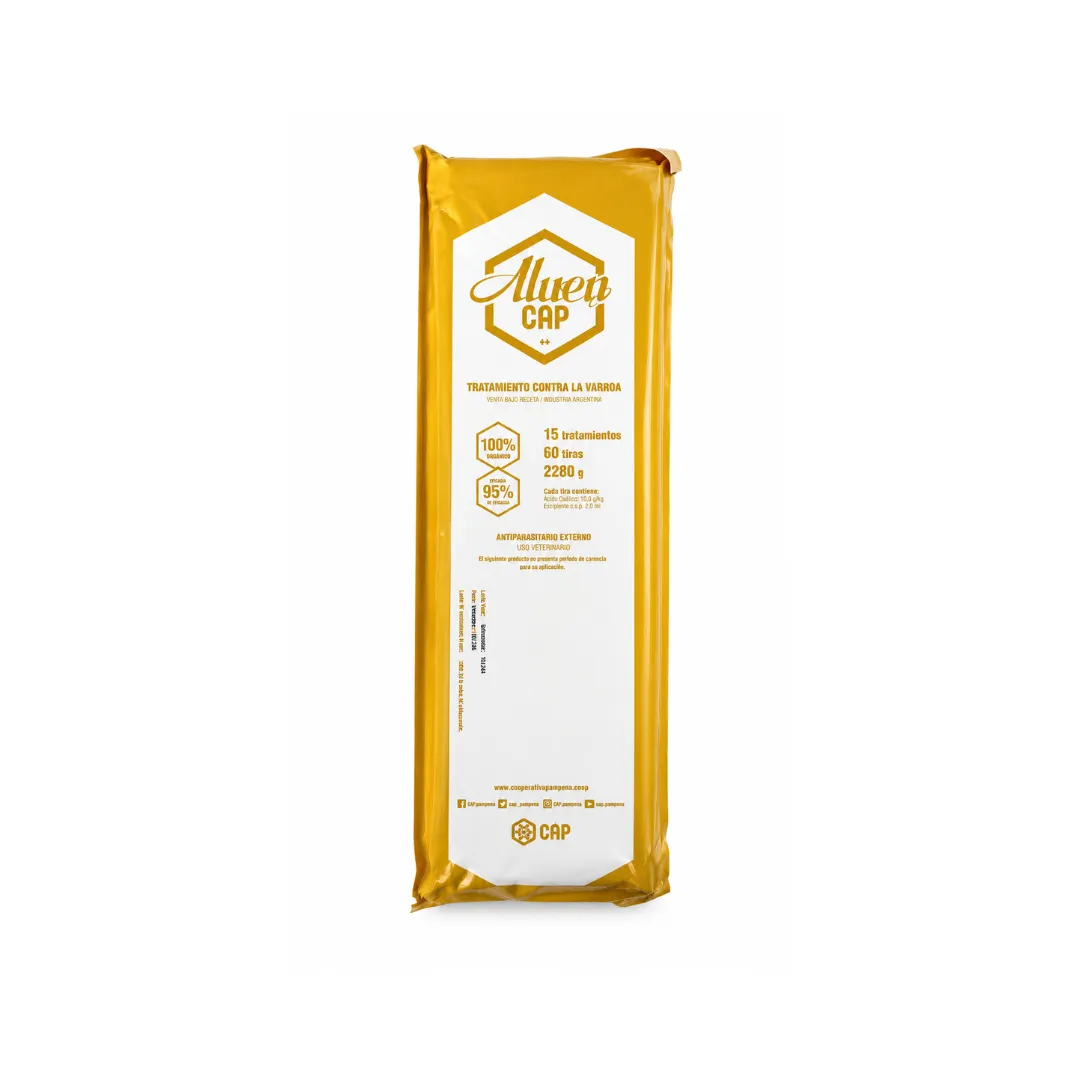
Our store listing says the pack holds 60 slow-release strips to control Varroa destructor, the dose is 4 strips per colony, it yields up to 15 treatments, and the strips go in the brood chamber. The listing gives no use temperature, concentration or safety warnings: for those you must read the product label. It is sold with no returns. Catalog reference price: RD$ 2,500.00 (Aluen CAP® 60 Strips, Oxalic Acid Varroa Treatment), see the listing.
With a manufacturer-linked document and an official authority document that we opened:
- An article published on acboonline.com attributes Aluen CAP to the Cooperativa de Trabajo Apícola Pampero in Argentina. It describes four cellulose strips impregnated with oxalic acid, acting by contact, that stay 42 days in the hive. It claims an average efficacy of 95% with or without brood. It is the developer's text and does not reproduce the studies; take it as a claim, not proof.
- Permit PER95790 from Australia's authority (APVMA), valid from 16 December 2025 to 30 June 2027, describes it as an unregistered product in that country, with 10 g of oxalic acid dihydrate per strip. It sets 4 strips for 8 to 10 frame hives, 42 days in place, no more than once a year or over two consecutive periods, and treating all colonies in the apiary at the same time. It lists a 0-day honey withholding period under that permit.
That is what those documents from another country say. We could not verify Aluen CAP's registration in the Dominican Republic, so the final word is the label in the package and your technician's advice. Oxalic acid treatment calls for gloves and protection for hands and airways: see our protective gear and the health and feeding section.
Monthly varroa monitoring checklist
Do this once a month and write it down: the trend matters more than a single count.
| When | What to do |
|---|---|
| First week of every month | Alcohol wash on at least 2 colonies in the apiary. Record the date, mites per 100 bees and the brood frame pattern. |
| If the count passes your threshold (reference: 3 per 100) | Pick a bee-labeled treatment from the table above. Check the next days' temperature and that there are no honey supers that must come off. |
| During treatment | Check brood and queen. Note any unusual mortality. |
| When treatment ends | Repeat the alcohol wash to see whether it worked. If the count did not drop, do not repeat the same product: change the active ingredient. |
| January and February | Measure when installing colonies, 6 to 8 weeks before the main flowering (calendar in the starter guide). |
| July and August | Measure after harvest and decide before putting supers back. Read the honey harvest guide. |
| September to December | Measure at the start of the dearth, when colonies are weakest. |
What we could not verify
- Whether Mavrik 24 EW is authorized or prohibited in the Dominican Republic, and whether a Dominican label exists. No opened source says.
- Which products on the IDIAF list (2022) are still registered today and where they are sold. We looked for Digega/Ministry of Agriculture guidance on bee acaricide registration and did not find it.
- The use temperature for Aluen CAP, Bayvarol and Apistan, which does not appear in the documents we opened.
- Data on varroa resistance to thymol, formic acid and flumethrin in our sources.
- A Dominican threshold for the alcohol wash.
Frequently asked questions
What is Mavrik 24 EW?
It is an agricultural insecticide with tau-fluvalinate as the active ingredient, in a water-based emulsion of 240 g per liter. The manufacturer labels we opened describe it for ornamental plants and do not include hives or varroa.
Can Mavrik be used against varroa?
No label we opened authorizes it. In an Algerian study, a Mavrik preparation reached 44% efficacy against 78% to 92% for bee-labeled products. We give no doses or methods and recommend products made for hives.
Are Mavrik and Apistan the same thing?
No. They share fluvalinate, but Apistan is a strip registered for hives, with directions for use and removal, while Mavrik is a concentrate for spraying plants with other ingredients in its formula.
When should I treat my colonies?
When an alcohol wash passes your threshold. Mississippi State uses 3 mites per 100 bees from May to October. IDIAF says to measure before, during and after each treatment and sets no number, so ask your local technician.
Which treatment can I use with honey supers on?
It depends on each product's label. The opened sources allow formic acid with supers and ask you to remove them for amitraz and thymol. For oxalic acid the tables disagree. Always read the label.
Is Aluen CAP registered in the Dominican Republic?
We could not verify it. Our store listing describes it as a veterinary beekeeping acaricide. To confirm registration, ask Digega or your association technician, and message us on WhatsApp if you have product questions.
Sources
- Canals, M. (2022). Guía sobre Manejo Integrado de la Varroosis. Instituto Dominicano de Investigaciones Agropecuarias y Forestales (IDIAF). idiaf.gob.do
- ADAMA East Africa. Mavrik 240 EW (product page, updated October 31, 2021). adama.com
- US Environmental Protection Agency (2022). Mavrik Aquaflow Insecticide/Miticide, EPA Reg. No. 2724-478, label accepted July 1, 2022. Wellmark International. epa.gov
- Benito-Murcia, M. et al. (2021). "Residual Tau-Fluvalinate in Honey Bee Colonies Is Coupled with Evidence for Selection for Varroa destructor Resistance to Pyrethroids." Insects 12(8), 731. pmc.ncbi.nlm.nih.gov
- Al Toufailia, H. and Ratnieks, F. (2016). "How Effective is Apistan at Killing Varroa?" Bee Craft 98(2). Laboratory of Apiculture and Social Insects, University of Sussex. sussex.ac.uk
- Adjlane, N. et al. (2013). "Evaluation of the efficacy of different acaricides against Varroa destructor in Algeria." Acarina 21(2): 141 to 146. kmkjournals.com
- University of Hawaii, CTAHR. Available Varroa destructor mite treatments for honey bees in Hawaii. cms.ctahr.hawaii.edu
- Heroes to Hives / SARE (2025). Varroa mite treatment cheat sheet. projects.sare.org
- US EPA. Apivar, EPA Reg. No. 87243-1, label. epa.gov
- Harris, J. W. Mississippi State University Extension. "Sampling for Varroa Mites Using an Alcohol Wash." extension.msstate.edu
- Australian Pesticides and Veterinary Medicines Authority. Permit PER95790, Aluen CAP slow-release oxalic acid strips for beehives (December 16, 2025 to June 30, 2027). permits.apvma.gov.au
- ACBO online. "New Organic Treatment for Varroa Mite, Aluen Cap, Arrives to the Caribbean." acboonline.com
Catalog reference prices from Quisqueya Hive as of October 2026, subject to change. Specifications of our products come from the store listings. This guide is informational and does not replace the product label or a technician's advice.
Browse the health and feeding section, the tools catalog or message us on WhatsApp: we can guide you with the product listings and, for diagnosing your apiary, your local technician.
0 Comments