
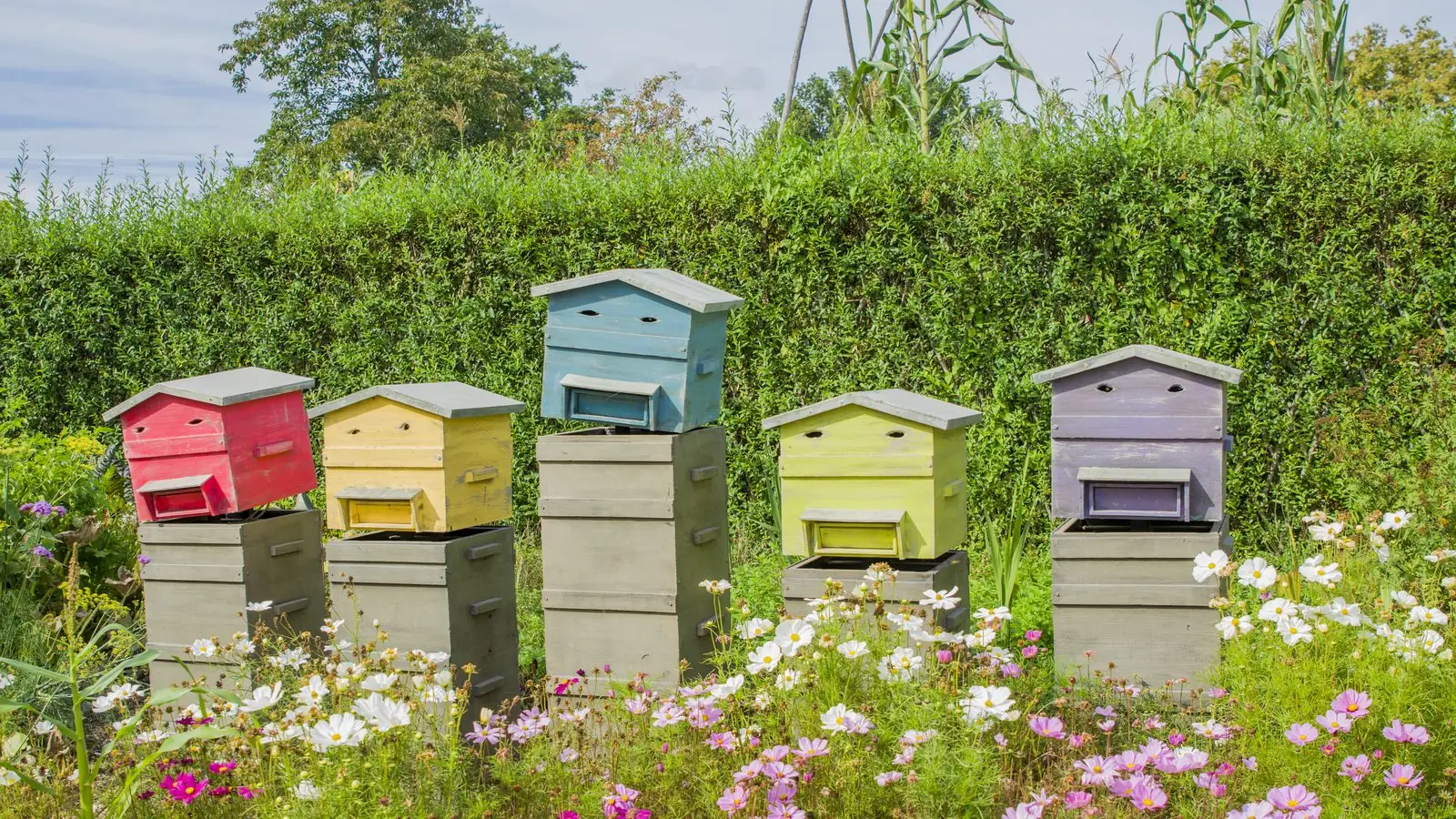
A bee box is the standard-size wooden body that holds the frames and the colony; a Langstroth hive stacks several of them. What matters most when buying is the height (deep body, 3/4 or medium super), the width (8 or 10 frames) and that the dimensions are the standard ones, so everything you buy later still fits. Here is the vocabulary, the sourced measurements, how much a full box weighs, how to choose, and what to check before you pay.
- Box, body, super and medium super are the same part in different heights. The brood nest uses the deep body; honey usually goes in shorter boxes because they weigh less.
- A full 10-frame deep box can reach about 80 lb (36 kg) and a full medium super about 50 lb (23 kg), according to one equipment supplier's estimates. That is why shorter supers exist.
- 8-frame and 10-frame boxes do not interchange: same length, different width. Pick one system and stay with it.
- Wood alone is not enough in the tropics: exterior paint, firm corners, dry lumber and keeping the hive off the ground count for more than the name of the wood.
- "3/4" is not a standard name everywhere. Always ask for the exact height of the box and of the frame before buying.
What is a bee box and what are its parts called?
In everyday searches, "bee box", "hive box" and "beehive" are used almost as synonyms. To buy well it helps to separate them, because each word is a different part at a different price.
| Term | What it is |
|---|---|
| Hive | The whole assembly: bottom board, boxes, frames and cover, with the colony inside. |
| Box | Each rectangular module, with no bottom or lid, that gets stacked. This is what people search for as a "bee box". |
| Deep body | The tallest box. Used as the brood chamber, where the queen lives. |
| Super | Any box placed on top so the bees can store honey. |
| Medium super | A shorter super. Lighter when full and easier to lift. |
| 3/4 box | A height between the deep body and the medium super. A regional name (see below). |
| Nucleus (nuc) | A narrow box for fewer frames, holding a small colony. |
| Bottom board | The base with the entrance and, on ours, a landing board. |
| Cover | The outer lid. The one in our catalog has a zinc lining. |
| Frames | The movable frames where the bees build comb. |
| Queen excluder | A grid that lets workers through but not the queen, between the brood and the supers. |
The diagram shows the order from bottom to top and what each part does. If you are setting up your first apiary, the full equipment list is in our beginner equipment guide; here we focus on the boxes.
In our catalog, the Box of Embossed Wax Foundation Sheets is not a box for housing bees: it is a pack of embossed wax foundation sheets for frames. If you want a home for the bees, see the hive catalog.
What are the dimensions of a Langstroth box?
A 10-frame Langstroth box measures 16 1/4" x 19 3/4" (405 x 505 mm) outside and 14 3/4" x 18 1/2" (365 x 465 mm) inside, according to the FAO. What changes between deep, 3/4 and medium is only the height: length and width stay the same.
Makers and sources differ by fractions of an inch (one source gives 16" x 19 7/8" outside), and Wikipedia notes that manufacturers' dimensions generally differ by 1/8" (3 mm) or less. So the practical rule is to compare the seller's numbers against your frames and your other boxes, not to trust the name.
Table of heights, frames and weight
Heights and frames come from the sources cited; weights are full-of-honey estimates for 10-frame and 8-frame boxes from Glory Bee, a US supplier. Real weight depends on how much honey and comb the box holds, so read them as orders of magnitude.
| Box type | Box height | Frame height | Full, 10 frames | Full, 8 frames | Typical use |
|---|---|---|---|---|---|
| Deep body (standard) | 9 5/8" (244 mm) | 9 1/8" (230 mm) | 80 lb (36 kg) | 60 lb (27 kg) | Brood chamber; the colony lives here. |
| 3/4 super | 7 1/2" (185 mm), per the FAO | 7 1/4" (175 mm) | No sourced figure | No sourced figure | Honey, lighter than a deep. |
| Medium super | 6 5/8" (168 mm) | 6 1/4" (160 mm) | 50 lb (23 kg) | 40 lb (18 kg) | Honey; some people use it for brood too. |
| Shallow super | 5 3/4" (146 mm) | 5 3/8" (140 mm) | 40 lb (18 kg) | 30 lb (14 kg) | Honey, the lightest. Not in our catalog. |
Heights for deep, medium and shallow come from Wikipedia ("Langstroth hive"), the 3/4 from the FAO, and weights from Glory Bee. The exact dimensions of our Langstroth 3/4 Hive Body are not in the catalog listing: ask us for the height before buying if you will mix it with other boxes.
8 frames versus 10 frames
| 10 frames | 8 frames | |
|---|---|---|
| Outside size (width x length) | 16" x 19 7/8" | 14" x 19 7/8" |
| Inside width of a deep body | 14.75" (370 mm) | 12.25" (310 mm) |
| Approximate inside volume of a deep body | 42.75 L | 35.5 L |
| Full weight of a deep body | 80 lb | 60 lb |
Sources: Glory Bee for outside sizes and weights, Wikipedia for inside widths and volumes. Frames have the same length in both systems, but the width differs, so an 8-frame box does not sit on a 10-frame one or share its bottom board or cover. Glory Bee recommends 8-frame boxes for people who find heavy lifting hard (they weigh more than 20% less), and warns that with less room you must watch crowding to avoid swarming. Our catalog is 10-frame.
Why does bee space matter?
Bee space is the open gap, about 6 to 9.5 mm (1/4 to 3/8 inch), that bees leave alone: if it is smaller they seal it with propolis, if it is larger they build comb in it. It is the reason frames move without tearing anything.
Wikipedia sums it up: Langstroth's 1852 patent set 3/8" (9.5 mm) as the upper limit, and the usual figure today is 7 ± 2 mm. In practice, if a box is badly cut, or the frames do not sit at the right width, you get burr comb between boxes, boxes glued together with propolis, and every inspection turns into a hive-tool fight. That is why the manufacturing margin is so small and why "almost the same" cut does not work.
To check without special tools, put a frame into the empty box: it should go in and out without forcing and leave an even gap, neither tight nor loose, at the sides and on top.
How much does a full box weigh, and how does that choose your super?
A deep body full of honey weighs about 80 lb (36 kg) and a full medium super about 50 lb (23 kg), according to Glory Bee. If you lift boxes by hand at inspections or at harvest, the height you choose is also a decision about your back.
That is where the logic of shorter honey supers comes from: more boxes, but each one more manageable. The price of that trade is more frames to uncap and more boxes to move, because less volume per box means more boxes to store the same honey.
- If you work alone and lift full boxes several times, a medium or 3/4 super is the kindest.
- If you have help and prefer fewer boxes per hive, deep bodies for everything work, but they weigh about twice a shallow.
- If you have physical limits, an 8-frame box weighs more than 20% less than a 10-frame, according to Glory Bee.
What does a "double 20-frame box" mean?
A "double 20-frame box" is a 10-frame hive with two bodies stacked, each holding 10 frames, 20 in total. It is not a different box: it is two regular boxes one on top of the other.
In the catalog this is the 10 Frame Langstroth Hive with 2 Deep Boxes (RD$ 3,882.20), also available with linseed oil as Langstroth 10-Frame Hive with 2 Deep Boxes - Linseed Oil Finish (RD$ 4,000.00). It fits two cases: a double brood chamber, for a colony that needs more laying room, or a brood chamber plus a second box used as a honey super. The difference between the two is how you manage it, not how it is built. Our guide on getting started in beekeeping explains when to add space.
How many boxes does a colony need through the year?
There is no fixed number that works for the whole country: it depends on the colony's size and your area's nectar flow. We found no Dominican source that gives a figure, so this is a shop rule of thumb, not research.
- Start: a nucleus (4‑Frame Langstroth Nuc Hive in American Pine, RD$ 855.50) or a one-body hive (10 Frame Langstroth Hive in American Pine, RD$ 2,436.70).
- Growth: when the bees cover almost all the frames, add space: a second box or a super.
- Nectar flow: supers go on top, usually with a queen excluder between brood and honey.
- After harvest: store empty boxes dry and ventilated; put them back when the next flow arrives. See the flowering calendar in the starting guide.
Buying too much at the start ties up money in boxes the bees will not use yet. A sensible approach is to buy the box you will need in the next two months.
Which box should I choose? A decision list
| If your case is... | Choose | Catalog item |
|---|---|---|
| It is your first hive and you want to start today | 10-frame hive with 1 body, bottom board and cover | 10 Frame Langstroth Hive in American Pine |
| You have a colony and want room for honey | Hive with a body and a medium super, or a body and a 3/4 super | 10 Frame Langstroth Hive with Deep Box and Medium Super or 10 Frame Langstroth Hive with Deep Box and 3/4 Box |
| You want a double brood chamber | Hive with 2 deep bodies | 10 Frame Langstroth Hive with 2 Deep Boxes |
| You already have a hive and only need one more box | Empty deep body or empty medium super | Langstroth Deep Hive Body - 10 Frame or Empty Langstroth Medium Super in American Pine - Linseed Oil Finish |
| You will split colonies or raise queens | 4-frame nuc and its super | 4‑Frame Langstroth Nuc Hive in American Pine and 4-Frame Nuc Super Box, American Pine |
| Your area is very humid or rainy | Linseed oil version, plus exterior paint if needed | Langstroth 10-Frame Hive in American Pine - Linseed Oil Finish |
| You lift boxes alone or have little strength | Shorter supers, or 8-frame boxes if you can source them | Medium or 3/4; the catalog is 10-frame |
If you are shopping the double box on price, always compare what is included: a box alone, a box with frames, or a complete hive. The catalog listings say what each hive includes; reference prices are as of the date at the end of this guide.
Wood and finish: what lasts best in the Dominican climate?
We found no Dominican source and no independent comparison of woods in tropical climates. What is backed by a university extension service, the University of Florida (a hot, humid climate), can be applied with judgment.
What the sources say
- The FAO prefers wood for boxes for its durability and for how it regulates temperature and humidity inside the hive, and says boxes painted outside last longer than unpainted ones. It recommends white, because it reflects sun.
- The University of Florida recommends kiln-dried, rot-resistant wood, and advises against pre-treated lumber, because preservatives can harm bees.
- The same publication advises painting only the outside, with two to three coats of non-toxic exterior paint, avoiding very dark colors (they absorb heat) and repainting every three to five years. Do not paint the inside faces of the boxes because it traps moisture; the bottom board can be painted entirely.
- For termites, the publication says oil-based exterior paint is still the best control, and that hives should be kept off the ground, on concrete blocks or ant-guard stands, not on wood. Stand legs can be coated with Tanglefoot or petroleum jelly to stop ants and subterranean termites.
- Screws and wood glue, caulked joints and rot-resistant wood reduce the need for preservatives, according to the same source.
American pine and linseed oil
Our boxes are American pine and come untreated or with linseed oil, for example the Empty Langstroth Deep Box in American Pine - Linseed Oil Finish and the Bottom Board - American Pine (10-Frame Langstroth) - Linseed Oil Finish. Linseed oil is a traditional treatment that suppliers offer as wood protection, but that claim comes from the sellers themselves, not an independent test, and we found no study comparing its durability to paint. Our honest recommendation: linseed oil is a good choice for wood inside and out without chemical paint, and where there is heavy rain or direct sun it makes sense to add exterior paint on the exposed surfaces and keep it up.
How do I judge a box's quality before paying?
A five-minute checklist avoids most problems. It is based on what the FAO says (corners are the weak point of a box) and the University of Florida (dry wood, glue and screws), plus the common sense of assembling and taking apart boxes.
- Corners. Look at how they join: they should be box-jointed or slotted, glued and nailed or screwed, not just butt-nailed. Pull on a corner: it should not move.
- Dry, straight wood. Set the box on a flat surface: it should not rock. Look for cracks, loose knots and damp stains.
- Fit with a frame. Slide a frame in: it should go in without forcing and leave an even gap at the sides and on top.
- Frame rests. The rabbet where the frame ends rest should be even, splinter-free and the same depth on both sides. The FAO gives 3/8" x 5/8" (10 x 13 mm) for that rabbet.
- Smooth surfaces. Top edges should be planed and burr-free: a box that does not sit flat leaves gaps where ants and moisture get in.
- Compatibility. Measure length and width and confirm they match your current boxes; for a 3/4, ask for the exact height.
- Finish. Ask what oil or paint it has and whether it is bee-safe. Avoid wood pre-treated with preservatives.
Can I mix boxes from different suppliers?
Yes, if the dimensions are the standard ones. The FAO recommends that all equipment in an apiary be of the same standard, Anglo-American or metric, for ease of operation and resale value. It also notes that metric figures are not exact conversions of the Anglo-American ones, but similar, not identical, measurements.
- Frames from one system do not fit boxes of another (Dadant, Layens and Langstroth do not mix).
- An 8-frame box does not stack on a 10-frame one.
- The bottom board and cover must match the width of the boxes.
- Wax foundation is sold for the frame height (deep, 3/4, medium): confirm it matches your frames. The Deep Langstroth Frame 9 1/8, Wired is a 9 1/8" deep frame.
Nucleus boxes: what are they for?
A nuc is a small hive, a narrow version of a Langstroth, for a colony that is just starting. Wikipedia says a typical nuc uses five Langstroth frames, about half the width of a 10-frame hive, and serves to split colonies, hold spare queens or prevent swarming.
Our 4‑Frame Langstroth Nuc Hive in American Pine (RD$ 855.50) holds four frames per the catalog name, and its super (4-Frame Nuc Super Box, American Pine, RD$ 590.00) gives extra room when the colony grows. When the nuc fills up, you move it into a full 10-frame hive.
Bottom board, cover and excluder
A box alone does not make a hive. From the catalog: the Bottom Board, American Pine (10-Frame Langstroth) (RD$ 472.00) and its linseed oil version Bottom Board - American Pine (10-Frame Langstroth) - Linseed Oil Finish (RD$ 501.50); the Hive Cover, American Pine with Zinc Sheet (RD$ 520.00); and the excluder in plastic, aluminum or galvanized versions. Confirm the width is 10-frame. To understand when to add each part, read the beekeeping equipment guide.
Frequently asked questions
What is the difference between a bee box and a hive?
The hive is the whole assembly: bottom board, one or more boxes, frames and cover, with the colony inside. The box is just one of those modules, with no bottom or lid. That is why a box alone costs less and an assembled hive includes everything to install bees.
What are the dimensions of a 10-frame Langstroth box?
According to the FAO, 16 1/4" x 19 3/4" (405 x 505 mm) outside and 14 3/4" x 18 1/2" (365 x 465 mm) inside. Height changes with the type: about 9 5/8" for the deep body and 6 5/8" for the medium super.
What is a 3/4 super?
It is a box with a height between the deep body and the medium super. The name is not standard in all countries; the FAO gives 7 1/2" (185 mm) for the 3/4 super. Always ask the seller for the exact height and compare it with your frames.
How much does a full honey box weigh?
According to one supplier's estimates, a 10-frame deep body reaches about 80 lb (36 kg) and a medium super about 50 lb (23 kg). It depends on how much honey is in it, so these are orders of magnitude, not guarantees.
Is an 8-frame or 10-frame hive better?
The 8-frame weighs more than 20% less when full, but leaves less room and means watching for crowding. The 10-frame is the most widespread and the one our catalog sells. You cannot stack boxes of both widths together.
What does linseed oil do on the boxes?
Suppliers use it as traditional wood protection. We found no independent test comparing it to paint. If your hive sits in sun or rain, add exterior paint on the exposed surfaces and keep it up.
Can I mix boxes from different suppliers?
Yes, if they all follow the same dimension standard. Compare length, width and height, and do not mix 8 and 10 frames. A maker may vary by 3 mm or less without problems; more than that affects bee space.
Sources
- FAO (1996). Chapter 5: Beekeeping with the common (European) honeybee, Apis mellifera. Food and Agriculture Organization of the United Nations. fao.org
- Wikipedia. Langstroth hive. en.wikipedia.org
- Wikipedia. Nuc. en.wikipedia.org
- University of Florida IFAS Extension. Protecting beehives from termites and decay (AA244). ask.ifas.ufl.edu
- Glory Bee. Bee box sizes and weights. blog.glorybee.com
Reference prices from the Quisqueya Hive catalog as of October 2026, subject to change. Specifications of our products come from the catalog listings. This guide is informational.
See the hive catalog or message us on WhatsApp with the dimensions of your current boxes: we will help you pick the piece that fits, no obligation.
0 Comments