
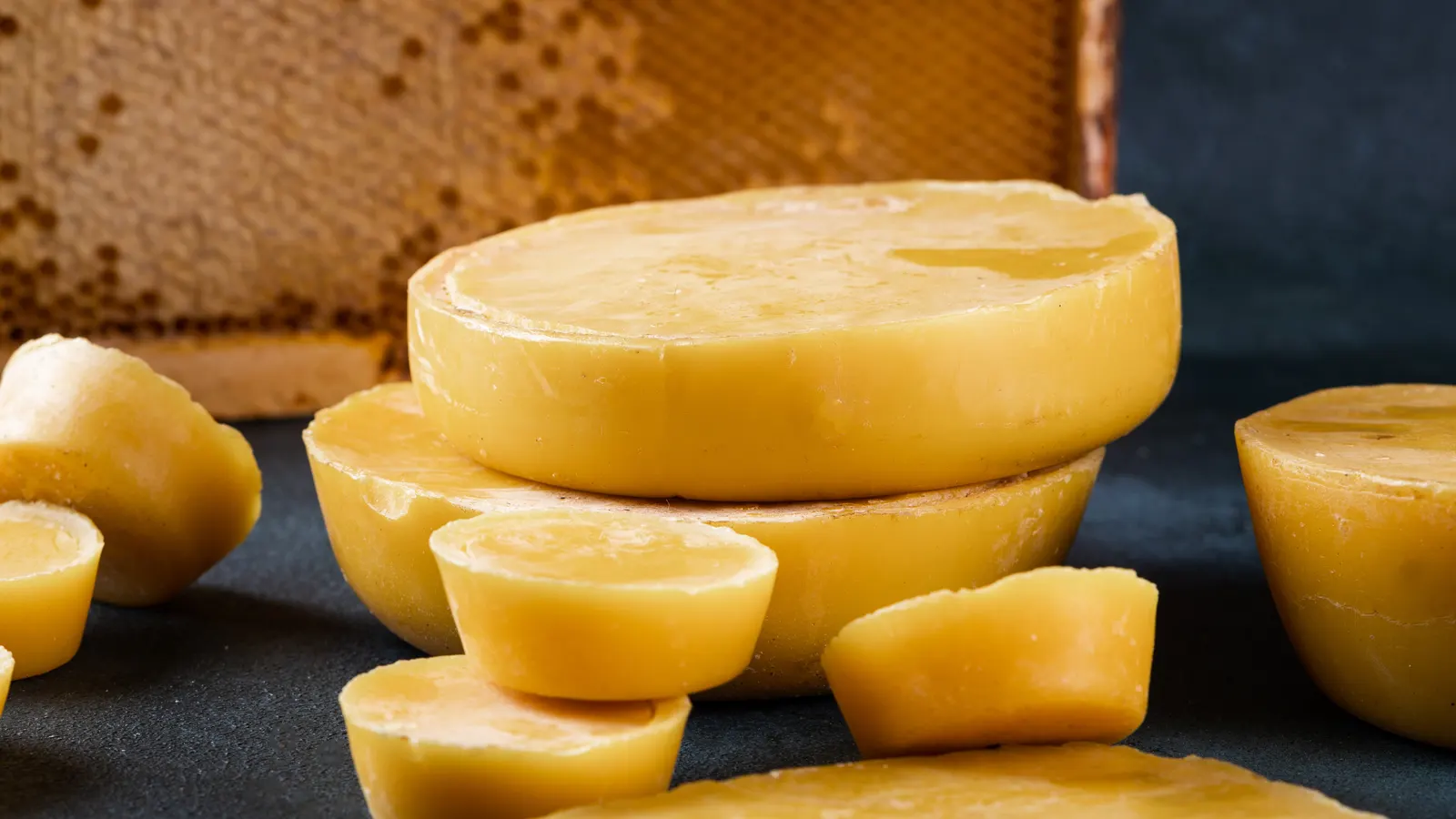
Beeswax comes from the cappings you cut at harvest and from the old comb you take out of the hive. To make it clean and reusable, you melt it with gentle heat and water, filter it while hot, let it cool slowly and store it dry. It is not hard, but it has two real risks: wax is flammable, and it darkens if it touches certain metals. This guide explains the methods, which one fits your number of hives, and how your own wax connects to embossed foundation.
- Where it comes from: cappings give the cleanest wax because they are new comb. Old comb gives darker wax with more dirt.
- Gentle heat: beeswax melts between 143 and 145 °F (about 62 to 63 °C). Above 180 °F (about 82 °C) it starts to discolor. Use a water bath, never direct flame.
- Filtering matters: in an Embrapa test with old comb and cappings, melting without filtering recovered 33% of the wax, with a sieve 54%, and with a submerged cotton bag 73%.
- Safety: wax is flammable. If it boils over onto the burner, there can be a violent fire. Keep the heat low, stay with it, and do not use water on burning wax.
- What it is for: your own foundation sheets, candles, or trading it to whoever presses sheets. For larger volumes, look at the beeswax press (RD$ 8,000.00).
Where does the wax you can use come from?
From two places: the cappings you cut before extracting honey and the old comb you remove from the hive. Both melt, but the wax they give is not the same.
Cappings: the cleanest wax
Cappings are the thin wax layer bees use to seal each honey cell. As University of Florida Extension explains, they tend to be the newest comb in the hive, which is why they give the cleanest wax. The MAAREC publication (University of Delaware) agrees: harvestable wax comes mainly from cappings, which the beekeeper removes before extracting honey. If you have not harvested yet, our honey harvest guide explains how and when to uncap.
To cut cappings, the catalog has the stainless steel uncapping knife with wooden handle (RD$ 600.00) and the uncapping roller (RD$ 550.00). To work in an orderly way and catch the cappings before they hit the floor, there are the stainless steel uncapping tray (RD$ 9,000.00) and the 304 stainless steel uncapping table (RD$ 47,200.00). They are harvest tools; you do not need them to melt wax, but they bring the material in cleaner.
Old comb: more wax, more dirt
Comb darkens with the years. According to Embrapa (Brazil), wax is white when produced but turns yellow and then black from propolis, pollen, pupal cocoons and other impurities. That is why renewing comb makes sense: the same source recommends replacing 30% of the combs every year, removing only dark, brittle or defective ones, and never those that still hold developing worker brood.
The comb you pull out is not trash: you melt it. And when you put in new frames, the usual route is embossed foundation, which we cover in the embossed wax foundation guide.
How much wax can you expect?
Not much, and it is better to know that before setting up a workshop. According to MAAREC, every 100 pounds of honey generally produces one to two pounds of wax. Utah State University gives the same proportion, 1 to 2 pounds per 100 pounds of honey harvested.
Embrapa adds a useful figure for anyone melting old comb: it cites an expected recovery of 30% to 50% of the wax in the combs. In other words, part of the wax stays in the residue, and how much depends on the method.
| If you harvest | Expected wax (1 to 2 pounds per 100 pounds of honey) |
|---|---|
| 50 pounds of honey | 0.5 to 1 pound |
| 100 pounds of honey | 1 to 2 pounds |
| 200 pounds of honey | 2 to 4 pounds |
| 500 pounds of honey | 5 to 10 pounds |
The table numbers are arithmetic from the cited proportion, not a measurement in the Dominican Republic. If you also melt old comb, you will get somewhat more. For context, Embrapa notes that bees need the energy equivalent of 7 to 10 kg of honey to make 1 kg of wax. That is why recovering it is worthwhile.
Which melting method is best: sun, water bath or press?
It depends on how much wax you have and how much cleanliness matters to you. The sources I opened document solar melting and the water bath in detail; for the press I found no source with data, so I will be honest about that.
Solar melter
According to University of Florida Extension, a solar melter is a box with a tight-fitting glass top, facing the sun, with a slanted tray (usually metal) inside. Painting the inside black helps absorb radiation. You put wax bits, old comb and scrapings on the tray; as the temperature rises, the wax melts and drips into a collector pan, which usually has slanted sides so the block comes out easily once it hardens.
The same source insists that the melter be bee tight, because bees are usually attracted to the odor of melting wax. In a sunny climate like ours it is a low-cost option, but I could not confirm times or yields from a source, so I give no numbers.
Water bath or hot water
Utah State University recommends melting slowly over low heat in a double boiler: a large pot of water with a smaller container on top, its bottom partly submerged, on medium heat or lower, stirring now and then. In the Embrapa test, samples went on low heat in stainless steel buckets immersed in 12 liters of water and isolated from the bottom, held at 70 to 80 °C for 50 minutes. That was the base method of the comparison.
MAAREC describes another variant: melting the wax in a tub of hot water. Wax is less dense and floats; nearly all impurities, honey in particular, are heavier and stay below. Once it cools, you lift the block from the top.
Wax press
The catalog has the beeswax press (RD$ 8,000.00). We only know its name and catalog listing, so I will not promise capacity or yield. If you have many hives or lots of old comb, message us on WhatsApp and we will tell you what we know before you decide. Given the loss Embrapa shows in methods without filtering, equipment that helps separate wax from residue makes sense when volume grows; for a few hives, you usually do not need it.
How they compare
| Method | Advantage | Keep in mind |
|---|---|---|
| Solar melter | No flame and no gas. Clean wax, especially from cappings. | Must seal well against bees. Depends on sun. |
| Water bath | Temperature control. Works for old comb and cappings. | Flame or heating element near flammable wax. Needs constant attention. |
| Press | Meant for larger volumes. | Ask our team for the information we do not have in the listing. |
How do you avoid burns and fires?
Wax is flammable. MAAREC puts it this way: if wax boils over or flows onto the burner, there is danger of a violent fire; it advises low heat and careful attention. That is the golden rule of this whole guide.
- Never direct flame. Use a water bath. The water limits the temperature of the wax container.
- Do not walk away. A pot of wax is never left alone, not even to answer the phone.
- Work with clear space. No curtains, papers or gas cylinders nearby. If you can, work outside, in shade and with ventilation.
- Keep a large lid at hand. To smother a flame, covering cuts off the air. Where to get a suitable extinguisher and how to use it, ask your local fire department; I found no source with instructions for wax, so I will not invent them.
- Do not put water on burning wax. This is a common safety warning for fats and waxes, but I did not find it in the university sources I opened; treat it as general precaution, not a study finding.
- Spills. Use gloves or thick cloths to move pots, and containers with firm handles.
Which utensils to use and which to avoid?
Use stainless steel and keep the utensils for wax only. MAAREC explains that wax darkens mainly from propolis contamination and from contact with containers of iron, aluminum, copper and some other metals, and that it is hard to lighten wax already darkened. For working, the same publication mentions stainless steel or properly tinned containers.
Utah State University adds a practical tip: dedicate pots and tools to wax, because it is very hard to get them fully clean.
For filtering, the sources use fine cloth (muslin, cheesecloth or a coffee filter, according to Utah) or a fine sieve (Embrapa). The catalog has two double stainless steel strainers, 32 cm (RD$ 1,700.00) and 16 cm (RD$ 1,100.00), sold for honey. I have no listing that says they work for wax, so ask us before buying them for that purpose; if you use them for wax, keep them away from honey.
Avoid solvents. Embrapa warns against using them to remove impurities from raw wax, because aroma and some components of beeswax are lost.
How do you process wax step by step?
This is the workflow we built from the three main technical sources (Utah, MAAREC and Embrapa). The order is what matters.
Wax rendering workflow
- Sort by quality. Cappings apart from old comb, so you do not spoil good wax with bad. MAAREC even suggests using dark wax for the first dips of a candle and saving the best for the last ones.
- Drain the honey. Keep cappings in a strainer so they drip. Remove dead bees and large debris and rinse with cool water, with light pressure so you do not lose wax (Utah).
- Set up the water bath. Water in the large pot, stainless steel container on top, low flame.
- Melt without going over 180 °F. Keep the temperature low and stir now and then. In the Embrapa test, 70 to 80 °C for 50 minutes fully melted the wax from comb and cappings.
- Filter. Use a fine sieve or cloth, or put the material in a cotton cloth bag inside the hot water, as Embrapa did. That gave the highest recovery.
- Let it settle and cool very slowly. Without moving the container. Moving it deforms the disc and mixes bottom impurities with the wax (Embrapa).
- Scrape the underside. If a layer of impurities remains, scrape it with a knife or spatula while the block is still warm, not fully cold (Embrapa). Do not put it in the refrigerator or freezer: fast cooling cracks wax (Utah).
- Check and repeat if needed. If color or impurities remain, filter again or repeat the process one or two more times (Utah).
- Store. Airtight container, dry place, away from sun (Utah), clean and free of strong odors (Embrapa).
Molds: Utah uses parchment-lined trays, silicone molds or jars. For blocks, University of Florida Extension suggests a bread pan with slanted sides, because the block comes out easily. Wax contracts as it solidifies, so a block can crack if it cools fast.
Which method fits my number of hives?
This table is our guidance, not a study result. We built it from the wax-per-honey proportion and from what the sources say about each method.
| Your apiary | Expected wax | Reasonable method | What you need |
|---|---|---|---|
| 1 to 3 hives | A few pounds a year | Water bath in small batches | Stainless steel pot set aside for wax, fine cloth, molds |
| 4 to 10 hives | Several pounds, more when you renew comb | Solar melter for cappings and water bath for old comb | Bee-tight melter, pot, filter |
| More than 10 hives | More wax and more old comb each year | Water bath plus a press, if its capacity suits you | Ask on WhatsApp about the press |
If you only have one or two hives, it is fine to keep cappings and comb scraps in a covered container and melt them all together once there is enough, instead of lighting a flame for a handful.
What is your own wax good for?
You have three main uses. The first connects to your equipment.
Your own embossed foundation
Clean wax can go back into the frame as foundation. The catalog has the beeswax sheet-pressing plate (RD$ 32,250.00), but we only know its name and catalog listing; if you plan to make your own sheets, ask us on WhatsApp what size it produces and how it is used. What matters: your sheet will only be as good as the wax you make it from. The foundation guide explains how to wire frames and how to avoid acaricide residues. If you prefer to buy it ready made, we have the embossed foundation sheet, sold individually (RD$ 60.00) and the box of embossed foundation (RD$ 4,500.00).
Trading it for foundation
Some workshops that press sheets accept wax in exchange for foundation, but terms vary by who presses. Ask them first, and remember this guide is not an offer to buy or sell raw wax.
Candles
MAAREC describes beeswax candles as slow burning with a pleasant aroma; it says that for molded candles you should melt the best wax in a stainless steel or properly tinned container in gently boiling water, and that wax contracts as it solidifies, so you need to top up the mold. A simple option is to roll an embossed sheet around a wick: the same publication mentions rolled foundation candles.
Frequently asked questions
At what temperature does beeswax melt?
According to MAAREC at the University of Delaware, between 143 and 145 °F, about 62 to 63 °C. Melt it with low heat and do not go over 180 °F, about 82 °C, because Utah State University says hotter wax discolors. Use a water bath to stay under it.
Can I melt wax directly on the stove?
It is not recommended. MAAREC warns that if wax boils over onto the burner there is danger of a violent fire, and Utah recommends a double boiler over low heat. The water under the pot limits the temperature of the wax container and lowers the risk.
Why did my wax turn dark?
According to MAAREC, the most common causes are propolis and contact with containers of iron, aluminum, copper and some other metals. Utah adds overheating above 180 °F. Once dark, wax is hard to lighten, so use stainless steel and gentle heat from the start.
How much wax do my hives give?
MAAREC and Utah agree on one to two pounds of wax per 100 pounds of honey. If you melt old comb, Embrapa cites a recovery of 30% to 50% of the wax in those combs, depending on the method. I have no Dominican data, so treat it as a reference.
Can I filter wax through a honey strainer?
The sources use a fine sieve or fine cloth such as muslin or cheesecloth. Our stainless steel strainers are sold for honey and we have no listing confirming their use with wax, so ask us. If you use them for wax, do not use them for honey again.
How do I store wax?
Utah recommends an airtight container in a dry place away from direct sun. Embrapa adds that the place be clean and free of strong odors, covered, ventilated and not humid. Let the block cool slowly and whole before you put it away.
Sources
- Ollé, T. de A., Wolff, L. F. and da Silva, E. H. (2018). Métodos simplificados de derretimento de favos e reciclagem da cera de abelhas. Boletim de Pesquisa e Desenvolvimento 316, Embrapa Clima Temperado. infoteca.cnptia.embrapa.br
- MAAREC (2020, revised). Beeswax. Publication 3.9, Mid-Atlantic Apiculture Research and Extension Consortium, University of Delaware. canr.udel.edu
- Meredith, B., Hunsaker, T. and Walker Bravo, A. (2024). Thriving Hives: Processing and Using Beeswax. Utah State University Extension. extension.usu.edu
- University of Florida IFAS Extension. Solar Beeswax Rendering and Hints for Exhibiting Wax Blocks (AA157). ask.ifas.ufl.edu
- Abeja Presumida (2018). Cómo fundir cera de abejas, método casero y fácil. Read as a comparison point for what Spanish-language guides explain. abejapresumida.com
Reference prices from the Quisqueya Hive catalog as of October 2026, subject to change. Temperature and yield figures come from the cited sources, mostly from the United States and Brazil; we have no Dominican data of our own. This guide is informational.
Message us on WhatsApp with your number of hives and we will help you decide whether you need the press, the sheet-pressing plate, or just a good pot and a filter. Delivery in 24 to 48 hours on business days; shipping cost is quoted on WhatsApp.
0 Comments